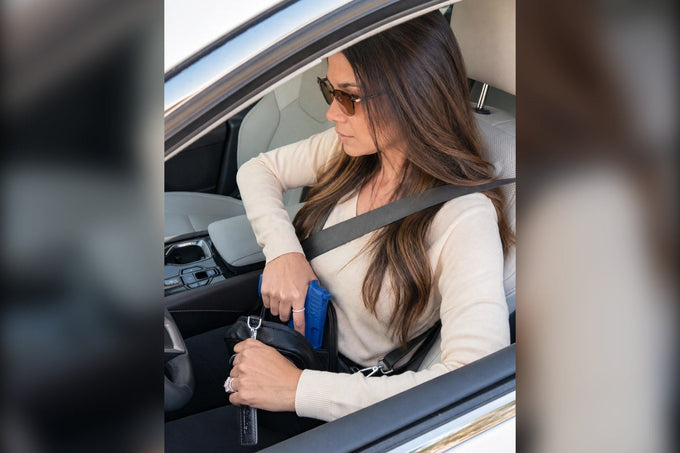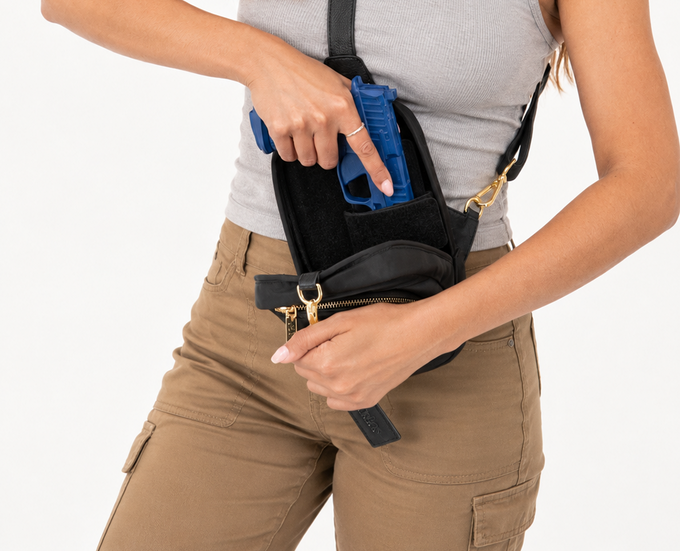

The most costly mistake in off body carry safety is letting the bag leave your control, even for a minute. Everything else depends on it, so this handbook gives you 7 rules, starting with that one: the bag stays on your body, in your hand or in locked storage, and the firearm inside it stays holstered, separated and under strict muzzle and trigger discipline.
A holster on your belt cannot be forgotten on a chair; a bag can. That is why these rules lean on habits more than on gear, and why the draw itself gets trained with an unloaded, verified-clear firearm long before you trust it in public. Each rule is laid out the same way, so you can come back to any one of them and find the answer fast.
Rule 1: Off Body Carry Safety Starts With Never Setting the Bag Down
The bag is on your body, in your hand or in locked storage, and there is no fourth place. The moment the strap leaves your shoulder, the firearm leaves your control.
Why it matters. A firearm on your waistband goes wherever you go. A firearm in a bag can be set down, picked up by someone else, carried off or opened by a child, and none of that requires anyone to touch you. Theft is the obvious risk. Unsupervised access is the worse one, because a child or a stranger may not know what is inside until the gun is in their hands.
A carry bag is also designed to look like any other bag. That is the point of it. The habits you built with ordinary purses over years, such as hanging it on a chair or tossing it on the passenger seat, feel just as normal with a carry bag, and nothing about the bag reminds you that it is different.
How to follow it. Wear the strap across your torso rather than on one shoulder, so the bag cannot slide off when you bend, reach or lift something. When you sit, the bag rests on your lap or stays against your side with the strap still on. Treat taking the strap off as a decision rather than a reflex: if the bag has to come off, the firearm goes into locked storage first.
Watch for the places where this rule usually breaks:
- Restaurant chair backs. The bag hangs behind you, out of sight, at the height of a passing child.
- Shopping cart seats. One turn to read a shelf label and the cart and carry bag is accessible to anyone around.
- Restroom stall hooks. A hook on the door can often be reached from outside the stall.
- Passenger seats. A bag on a car seat is visible through the window and gone in seconds.
- Office chairs and desks. Coworkers, visitors, and cleaning crews pass by all day.
What it looks like when it goes wrong. The pattern is almost always a short interruption rather than a careless day. The bag goes into a cart seat while you compare 2 labels. It goes on a hook because both hands are full. It stays in the car for a quick errand. None of these feel like leaving a firearm unattended while they happen, which is exactly why the rule has no exceptions for "just a minute."
Bag features that help. A crossbody strap that fits you matters more than any other feature for Rule 1. The Madeline XL-M page lists a strap length "Adjustable up to 49 inches, with a maximum circumference of 55 inches," and the Millie Athletic XL-M Nylon CCW Bag page lists "Adjustable to 49” for a max circumference of 55”." If the bag swings forward when you lean over a stroller or a car seat, the Waist Belt for CCW Bags clips onto either D-ring on the sides of a Cakes bag and goes around your waist to hold it closer to your body.
Rule 2: Holster the Firearm So the Trigger Guard Is Fully Covered
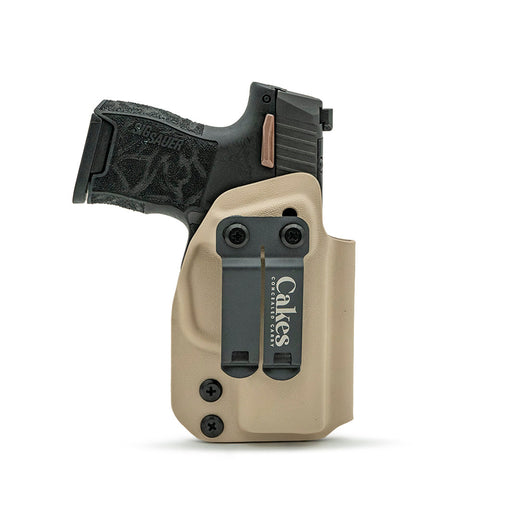
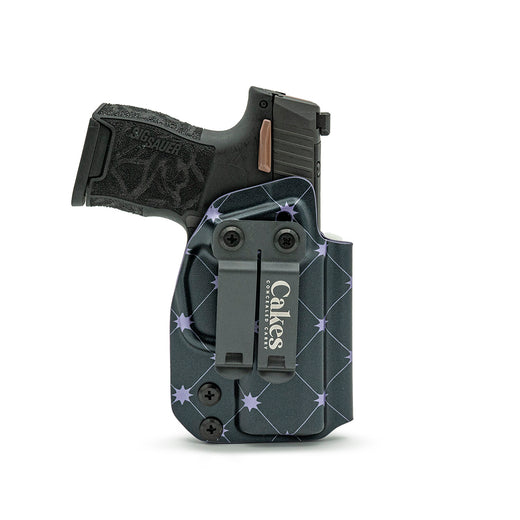
A firearm in a bag always rides in a holster that fully covers the trigger guard. A loose gun can shift as the bag moves, and anything that slides into an exposed trigger guard can press the trigger.
Why it matters. A bag is a moving container. It bumps against your hip as you walk, it gets squeezed in crowds and it gets tilted every time you sit down or stand up. A holster that covers the trigger guard keeps the one part of the firearm that must never be touched by accident out of reach of zipper pulls, strap hardware, pens, and fingers.
A holster also keeps the firearm in a fixed position. When you reach into the bag, your hand should find the grip in the same place every time. A gun that has rotated or slid during the day forces you to search for it, and searching is slow and unsafe.
How to follow it. Use a holster molded for your exact make and model. It should hold the firearm firmly enough that turning the bag upside down does not dislodge it, and it should stay anchored inside the bag when you draw, so the gun comes out and the holster stays put. Before each carry day, run a short check with your unloaded firearm until the look and feel of a correctly seated holster becomes automatic:
- The trigger guard is fully covered, with no gap at the front or the sides.
- The holster is seated firmly and does not slide when you shake the bag gently.
- Nothing is folded, bent or caught inside the holster mouth.
- The holster is clean, uncracked and free of lint or grit.
What it looks like when it goes wrong. A generic holster that fits several models leaves a gap at the front of the trigger guard. A holster that is not anchored to the bag comes out still attached to the gun, so you end up holding a holstered firearm in the middle of a draw. A holster that sits at an angle because the bag is too small presses the grip into the bag wall, where it is hard to reach cleanly. Each failure starts small and gets worse under stress.
Bag features that help. Look for a bag built with a place for the holster and a way to fix it there. The Madeline XL-M page lists "Space for a holster along the inside back of the bag," and the Cakes holster collection includes IWB holsters made for on-body wear and for use inside a Cakes bag, which "attach directly into your Cakes bag with a hook and loop back panel." Check the collection for the models and styles available, and confirm the fit of any holster before you carry with it.


Rule 3: Give the Firearm a Compartment of Its Own
The gun compartment holds the holstered firearm and nothing else. Keys, a phone, lip balm and loose change belong in the other pockets, every day, without exceptions.
Why it matters. Shared space causes 2 problems. It slows the draw, because your hand has to sort through objects to find the grip. It also puts small, hard items next to the holster mouth, which is exactly where you never want them. Both problems grow over time, because bags collect things.
This is one of the most common concealed carry purse mistakes, and it rarely starts as a decision. It starts with one item tucked beside the holster during a rush, and then the item stays there.
How to follow it. Decide which compartment is the gun compartment and keep it empty of everything else. Once a week, open it and look: if anything other than the holstered firearm is inside, move it. Keep your most-used items in the pocket you reach most often, so you are never tempted to open the gun compartment for a phone or keys. Finally, make sure your setup fits the bag before you rely on it.
Fit is part of Rule 3 because a crowded compartment and a too-small compartment fail the same way. Run your make, model and setup through the Does It Fit? tool. One of its rules reads: "Firearm + Holster Length must be 0.5 in less than the bag's internal height." The tool also adds height for a Kydex holster, an optic and an extended magazine, and adds length for a weapon-mounted light, so enter your setup as you actually carry it.
What it looks like when it goes wrong. A key ring rides down beside the holster and the grip now sits a half inch higher on one side. A pen finds its way under the holster and tilts it. A phone sits on top of the grip, so your hand meets glass instead of the firearm. None of this is dramatic, and all of it makes the draw slower and the trigger guard less protected.
Bag features that help. Choose a bag with a dedicated firearm compartment and a separate space for everything else. The table below shows how the current Cakes crossbody bags describe their compartments and closures on their own product pages. Browse the CCW bags collection for every style.
| Bag | Material | Compartment and closure (as listed) | Dimensions (as listed) | Price |
|---|---|---|---|---|
| Madeline XL-M | Leather | Magnetic closure with a tab; N45-strength neodymium magnets keep the main CCW compartment closed; space for a holster along the inside back | 6.6 in W x 9 in H x 2.16 in D | $205 |
| Madeline Compact-M Leather CCW Bag | Leather | Magnetic closure and pull tab you pull down for access; crossbody or handheld | 5.6 in W x 8 in H x 2.16 in D | $185 |
| Millie Athletic XL-M Nylon CCW Bag | Nylon | Dedicated, separate firearm compartment; magnetic pull tab access | 6.7 in x 9 in x 2 in | $190 |
| Millie Athletic Compact-M Nylon CCW Bag | Nylon | Dedicated firearm compartment (see page for closure details) | 5.7 in x 7.8 in x 2 in | $175 |
Listed on the live product pages as of October 2026. Prices as of October 2026, in US dollars; the product page always has the current figure.


These rules work with any well-built carry bag, including ones we do not make. Teaching them is part of what we offer, and whether you buy from us is not how we judge this handbook; a reader who carries more safely is.
Rule 4: Keep Muzzle and Trigger Discipline Every Time You Open the Bag
Opening a bag brings your hands and the muzzle close to your own body, so muzzle and trigger discipline matter even more off-body than on. Keep the muzzle pointed in a safe direction and your finger straight along the frame until your sights are on a target you have decided to shoot.
Why it matters. Off-body carry creates 2 specific risks. First, if your support hand holds the bag while your strong hand draws, the muzzle can sweep that hand or forearm as the gun clears the compartment. Second, when you re-holster into a bag, the holster mouth often sits against your body, so a hurried re-holster can point the gun at your own torso or leg.
How to follow it. Build both disciplines into the motion itself, so they do not depend on remembering:
- Muzzle: know where the muzzle points while the gun is still holstered in the bag, and keep your support hand clear of that line.
- Muzzle: draw along a path that never crosses your own body, your support arm or a person near you.
- Muzzle: if you cannot find a safe direction, do not draw; move first.
- Trigger: your finger stays straight on the frame and outside the trigger guard from the moment you open the compartment.
- Trigger: your finger enters the trigger guard only when your sights are on target, and leaves it before you lower the gun.
- Re-holster: slow down, look at the holster, and move the bag away from your body if you need to.
What it looks like when it goes wrong. The support hand pulls the bag forward and ends up directly in front of the muzzle. The trigger finger curls in as the gun comes out of the bag, because the hand is gripping hard to free it. The re-holster happens fast, with eyes on the room instead of the holster, and the muzzle drifts toward the hip. Pointing the muzzle at yourself or others is often called "flagging," and every one of these moments is a flag.
Bag features that help. One-hand access lets the support hand stay clear of the muzzle line. The Millie Athletic XL-M page lists "Magnetic pull tab access," and the Madeline Compact-M Leather CCW Bag page describes a magnetic closure and pull tab you "simply pull down for immediate access." Room inside the bag matters too. The second Does It Fit? rule reads: "Frame Height + Optic must be at least 0.5 in shorter than the bag's internal width to allow clean draw and re-holstering."
The Cakes education page also has a video titled "How to Draw From Your Cakes Bag Without Flagging Yourself." Watch it before you start dry practice, and do every rep with your unloaded firearm.
Rule 5: Train the Draw Before You Carry, Then Get It Checked
A bag draw has more steps than a waistband draw: open, reach, grip, clear and re-holster. Train it at home with your unloaded firearm first, then confirm it with live-fire training under a qualified instructor before you carry in public.
Why it matters. Under stress, people do what they have rehearsed. If you have never drawn from your bag, you will be learning the closure, the grip angle and the holster release at the worst possible moment. Rules 2, 3 and 4 only hold up under pressure if the motion is already familiar.
How to follow it. Set up every dry practice session the same way, and keep your unloaded firearm the only firearm in the room:
- Move all ammunition to a different room.
- Check that the firearm is unloaded twice, by sight and by feel: magazine out, chamber empty.
- Pick a safe direction, such as a wall or backstop that would stop a round, and keep the muzzle there for the whole session.
- Keep your finger straight along the frame until the sights are on target.
- Re-holster slowly while looking at the holster.
- Say out loud that the session is over before you reload, so your unloaded practice has a clear finish.
Keep each session with your unloaded firearm short and focused. Start by opening the compartment and finding your grip without drawing. Add the full draw only when the grip is consistent. Then repeat the draw standing, seated and walking, in the clothes you actually wear, because a bag sits differently over a coat than over a T-shirt. Repeat the full setup any time you change bags, holsters or carry position.
Home sessions build the motion; an instructor checks it. The Cakes instructor directory lets you enter a zip code to find firearms instructors within 200 miles. The page says Cakes Certified instructors are vetted and certified by the Cakes team, so they appear first, and community instructors are listed as well. Bring the exact bag, holster and firearm you carry, and ask the instructor to watch your bag position, draw path and re-holster.
What it looks like when it goes wrong. Speed comes before smoothness, and the reps get faster while the grip stays inconsistent. Training happens only standing, so the first seated draw is a surprise. The draw is trained but the re-holster is not, which leaves the slowest and most dangerous part of the motion unrehearsed. Or no instructor ever sees the draw, so a flag nobody noticed becomes a habit.
Bag features that help. A closure that opens the same way every time makes repetition worth more, because each rep builds the same motion. The Does It Fit? page includes a video titled "How to Fit Your Firearm in Your Cakes Bag," which is a good first step before any session with your unloaded firearm. For more on building the habit, read Training the Draw: Why Practice Matters as Much as the Gear, and for background on why many women choose bags in the first place, read Off-Body Carry and the Female Self-Defense Movement.
Rule 6: Move the Firearm Into Locked Storage the Moment You Get Home
When the bag comes off your body at home, the firearm goes into a lockbox or gun safe right away. A bag on a couch, a doorknob or a kitchen counter is within reach of any child looking for a snack, a phone or the car keys.
Why it matters. Children are drawn to bags because that is where interesting things live. They have watched adults reach into purses for treats and screens their whole lives. A dedicated compartment and a magnetic closure keep a firearm secure while you carry it; neither one is a lock, and neither is built to stop a curious child or a visiting teenager.
How to follow it. Build a short arrival routine and run it the same way every day:
- Walk in with the bag still on your body.
- Go straight to your lockbox or safe before you put anything else down.
- Move the holstered firearm into locked storage, unloading it first if that is part of the routine your instructor taught you.
- Lock the container, then hang up the empty bag.
- Reverse the order when you leave: the firearm goes into the bag only when the bag is going on your body.
Apply the same routine when guests visit, especially guests with children; their curiosity about your bag is no different from your own child's. Vehicles need the same thinking. A bag on the seat or the floor is not secure storage, and some states set specific rules for how a firearm must be stored in a vehicle, so check them before you leave one there.
Project ChildSafe, the National Shooting Sports Foundation's safety program, distributes free gun locks and safety kits along with storage guidance for families. Talk with children about what to do if they ever find a gun: do not touch it, leave the area and tell an adult.
What it looks like when it goes wrong. The bag gets dropped on the couch because the phone is ringing. It gets hung on a hook by the door, at the exact height a child can reach. It goes on the bedroom floor overnight because the lockbox is in another room. Each one is the same mistake as Rule 1, made at home instead of in public.
Bag features that help. No bag feature replaces a lock. What helps is a setup that makes the transfer quick: a holster anchored in a dedicated compartment lets you move the firearm in one deliberate motion. Keep the lockbox where you walk in, not across the house, so the routine costs seconds rather than minutes.
Rule 7: Check State Law and Venue Rules Before You Carry Somewhere New
Carry laws vary by state and change often, so check current state law before you carry in a bag, and check again before you travel. This section is general information, not legal advice.
Why it matters. States regulate where you may carry, how a firearm must be stored in a vehicle and, in some cases, how they define carrying a firearm on or about your person. Schools, government buildings, airports and private businesses can each set their own rules, and those rules apply to a firearm in a bag the same way they apply to one on your belt. A bag that looks like an accessory does not change what is inside it.
How to follow it. Check your current state law and any local rules before you carry, and confirm the rules for every state on a travel route, not just your destination. Read posted signs at venues. Ask a certified instructor about your state's specifics, including vehicle storage. Firearms are not allowed in carry-on bags on US flights, so a carry bag with a firearm never goes through airport security; check TSA and airline rules for checked baggage. A good resource to find state laws and information on the rules for each state is the USCCA Reciprocity App.
What it looks like when it goes wrong. Home-state rules are assumed to apply across a state line. A carry bag goes into a building that prohibits firearms because it has become part of an everyday outfit. A firearm stays in a bag in the car in a state with different vehicle storage rules. None of these involve bad intent, and all of them can carry legal consequences.
Bag features that help. No bag makes carry legal where it is not. What a dedicated compartment does help with is planning: when you know you are heading somewhere you cannot carry, you can move the holstered firearm into locked storage at home before you leave, rather than discovering the problem at the door.
FAQ: Off Body Carry Safety
What is the safest way to carry a gun in a purse?
The answer to how to carry a gun in a purse safely is a dedicated compartment, a holster that fully covers the trigger guard and a crossbody strap worn across your torso. Keep the bag on your body, in your hand or in locked storage, and train the draw with your unloaded firearm before you carry.
Can I set my carry bag down for a minute?
Avoid it. A minute is enough for a child to open the bag or for someone to walk away with it. If you need both hands, keep the strap across your body and let the bag rest against your side. If the bag must come off, the firearm goes into locked storage first.
What are the most useful purse carry safety tips for home?
The most useful purse carry safety tips for home are about the moment you walk in. Move the holstered firearm into a lockbox or gun safe before you put anything else down, then hang up the empty bag. Project ChildSafe offers free gun locks and safety kits, plus guidance on talking with children about firearms.
Is off-body carry legal in every state?
Carry and storage rules change from state to state, and some venues add limits on where and how you may carry or store a firearm, including in a vehicle. Check your current state law and local rules, check each state on a travel route, and ask a certified instructor about your state. This answer is general information, not legal advice.