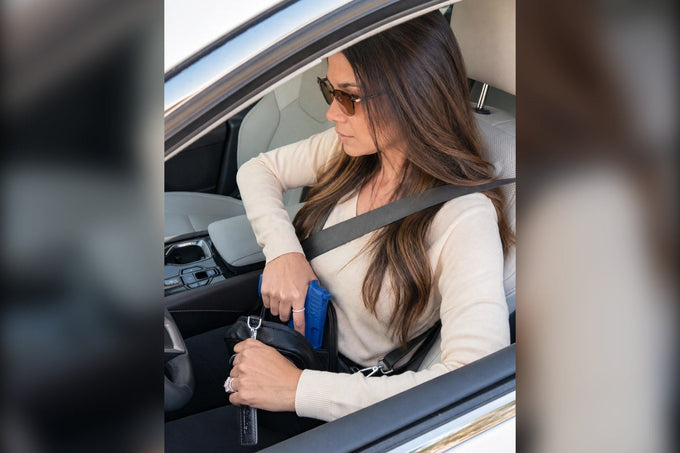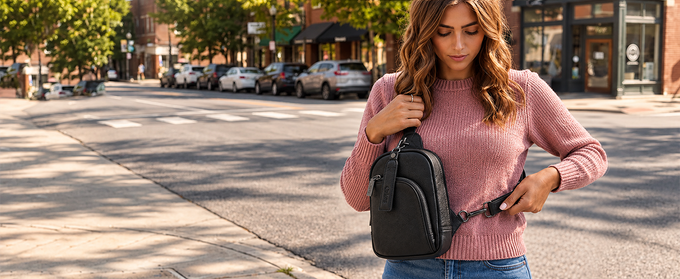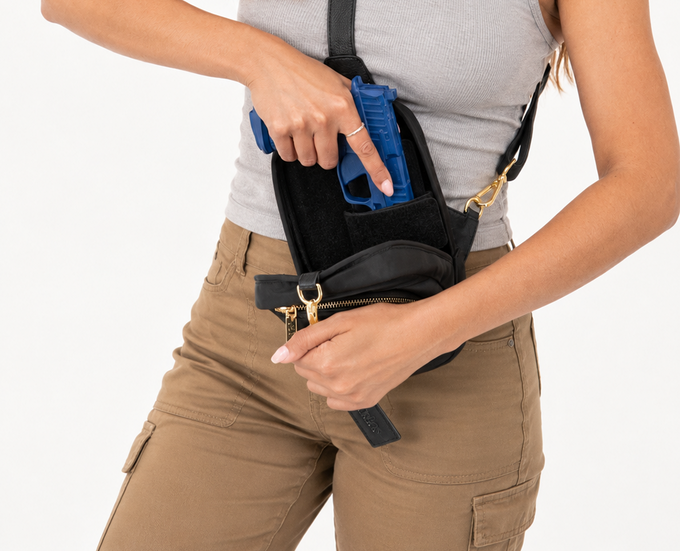

For daily off-body carry, a crossbody concealed carry bag is the better choice for most women: it rides in front of your body, where you can see it and reach the firearm compartment with one hand. A concealed carry backpack holds more gear, but you usually have to take it off before you can reach your gun.
This guide compares crossbody vs backpack concealed carry the way a firearms instructor would, by access, retention, concealment, and comfort. You will get a side-by-side table, the honest downsides of each style, a fit check to run before you buy, a setup routine, a 4-week practice plan for drawing with an unloaded, verified-clear firearm, and the 6 mistakes we see most often.
One note before you start. Cakes Concealed Carry makes crossbody bags, not backpacks, so we have an obvious interest here. We have tried to give the backpack a fair hearing anyway, because a well-informed carrier is the result we care about; a sale is not how we measure whether this guide did its job.
Learn the 3 Off-Body Carry Styles Before You Compare Them
Off-body carry means carrying a firearm in something you wear or hold, such as a bag, instead of in a holster attached to your waistband. Crossbody bags, sling bags and backpacks are the 3 off-body styles most women weigh against each other.
The strap layout decides where the gun sits relative to your dominant hand. That single fact drives most of the pros and cons in this guide, so get the definitions straight first.
Crossbody concealed carry bag
A bag with 1 long strap that runs from one shoulder diagonally across your chest to the opposite hip. The bag rests at your hip or slightly in front, close to where your hand falls naturally. Cakes designs its CCW bags around this crossbody configuration, which is why you will see them used as the examples here.
Sling bag
A sling also uses 1 strap across the torso. The difference is placement: the bag body is usually worn on your back or under your arm, then rotated to the front when you need it. Some brands use the words sling and crossbody for the same product, so read the description carefully.
Concealed carry backpack
A backpack with 2 shoulder straps and a dedicated firearm compartment, often a padded panel that sits against your back. Some brands also sell a smaller hybrid called a concealed carry backpack purse: a mini backpack styled like a handbag, still worn on the back.
Compare Crossbody vs Backpack Concealed Carry Side by Side
A crossbody bag wins on access speed, visibility and retention; a backpack wins on capacity and weight distribution. Use the table below to see where each style lands on the factors that matter when a firearm is inside.
| Factor | Crossbody bag | Backpack | Sling bag |
|---|---|---|---|
| Where the gun rides | Front or hip, in your line of sight | Behind you, out of view | Back or side; rotated forward for access |
| Hands needed to reach the gun | Usually 1 to draw; the support hand can steady the bag | Usually 2, after removing at least 1 strap | Usually 2 to rotate, then 1 to draw |
| Bag stays on you during the draw | Yes | Often no; many carriers set it down | Yes, if rotated in place |
| Can you see the gun compartment? | Yes, at a glance | No | Only after rotating |
| Capacity | Small to medium | Large | Small to medium |
| Weight distribution | 1 shoulder; heavy loads pull to one side | 2 shoulders; spreads the load | 1 shoulder |
| Snatch resistance while worn | Good, because the strap crosses the body | Good while worn; poor once set down | Good, because the strap crosses the body |
| Typical look | Handbag | Commuter or outdoor | Casual or athletic |
| Best fit | Errands, work, evenings out | Long commutes, travel days, hikes | Active days with light gear |
General comparison of bag styles as of October 2026. Individual products vary, so check each bag's own specs.
Read the table by your priority. If your question is "How fast can I reach my firearm without setting anything down?", the crossbody wins clearly. If your question is "How do I carry a laptop, water and a firearm on a long walk?", the backpack has the edge, with real trade-offs you will need to plan around (covered in the next 2 sections).
Weigh the Pros and Cons of a Crossbody Concealed Carry Bag
The main strengths of a crossbody concealed carry bag are one-handed access and constant contact with your body. Its main limits are capacity and the load it places on a single shoulder.
Pros
- Access from the front. The firearm compartment sits where your hand can reach it without taking the bag off.
- Better retention. Because the strap crosses your torso, someone would have to get it over your head or cut it to take the bag. A shoulder-only purse can be pulled away in one motion.
- You can see it. You notice when a zipper is open, when a child reaches for the bag, or when the strap has shifted.
- It reads as a handbag. In an office, a restaurant or a school pickup line, a crossbody draws less attention than a tactical-looking pack.
Cons
- Limited space. A compact crossbody holds a pistol plus a phone, keys and cards. A tablet, a water bottle or a jacket will not fit.
- One-shoulder load. A handgun plus daily items can tire one shoulder over a long day. Switch sides only after you have practiced the draw from that side with your unloaded firearm.
- The purse habit. Because it feels like an ordinary bag, people start hanging it on chairs and setting it in shopping carts. That habit cancels the retention advantage.
Cakes builds its bags around this style. The Madeline line is leather and the Millie Athletic line is nylon; each comes in a Compact-M and an XL-M size. The specs table later in this guide lists dimensions and strap length straight from the product pages, and the CCW bags collection shows every current style.
Weigh the Pros and Cons of a Concealed Carry Backpack
A concealed carry backpack spreads weight across both shoulders and holds far more than a crossbody. The trade-off is access: the firearm sits behind you, so reaching it is slower and usually takes both hands.
Pros
- Capacity. Room for a laptop, a first aid kit, a jacket and a water bottle along with the firearm.
- Comfort over distance. 2 straps balance the load, which helps on a long commute, a travel day or a hike.
- Blends in on campus and trails. In those settings a backpack is ordinary and draws no attention.
Cons
- Slow access. Most carriers slide off 1 strap, swing the pack to the front, open the compartment and only then draw. A crossbody needs 1 or 2 of those steps.
- Out of sight. You cannot see who is near the compartment, and you may not feel a zipper opening behind you.
- The set-down habit. Backpacks go on the floor, under desks, and into overhead bins more often than purses do. Each time, the firearm leaves your control.
- Shifting contents. When the main pocket is packed full, the firearm compartment can get compressed, which changes how the holster sits.
A word on the concealed carry backpack purse: the mini backpack looks like a handbag but keeps the backpack's access problem, because it still rides behind you. If you like the look, test the full access sequence with your unloaded firearm before you commit.
Cakes does not currently make a concealed carry backpack. If your days call for one, look for a dedicated firearm compartment that you can lock, a holster that fully covers the trigger guard, and a compartment you can open without unpacking the main pocket.
Tell a Sling From a Crossbody CCW Bag Before You Buy
A sling bag and a crossbody bag both use 1 diagonal strap. The difference is where the bag rests: a crossbody stays at your hip or front, while a sling usually rides on your back and gets rotated forward.
If you are researching sling vs crossbody CCW bag options, check how each brand expects you to wear the product, because the labels overlap. The Millie Athletic Compact-M page, for example, describes "adjustable crossbody carry," while its page title calls it a small concealed carry sling bag.
For carry purposes, the label matters less than one question: where will the firearm compartment be at the moment you need it? If it will be on your back, treat the bag like a backpack and plan for a 2-step access. If it will be at your hip or front, treat it like a crossbody.
Run the reach test. Put the bag on exactly the way you will wear it. Without looking down, reach for the zipper or pull tab of the gun compartment with your dominant hand. If you have to twist the bag around first, that twist is now part of your draw, and it belongs in your practice plan with your unloaded firearm.
Measure Your Firearm Before You Pick a Bag
Size decides whether a bag works at all. Your firearm and holster need to fit the interior with enough room to draw and re-holster cleanly, whichever style you choose.
The Does It Fit? tool on the Cakes site applies 2 rules, quoted here exactly:
- "Firearm + Holster Length must be 0.5 in less than the bag's internal height."
- "Frame Height + Optic must be at least 0.5 in shorter than the bag's internal width to allow clean draw and re-holstering."
You pick your make and model, and the tool fills in the length and frame height. It then asks about your setup, because accessories change the total size. On the tool, a Kydex holster adds 0.5 in to height, an optic adds 0.5 in to height, an extended magazine adds 1.5 in to height and a weapon-mounted light adds 1 in to length.
Hypothetical example: if your pistol plus holster measures 7.0 in long, the first rule points you to a bag with an internal height of at least 7.5 in. Add a weapon-mounted light and that length grows by 1 in, so the bag needs at least 8.5 in of internal height.
Product pages list dimensions without labeling them as internal, so run the tool rather than guessing from outside measurements. If you measure the pistol yourself, use your unloaded firearm, measure on a table pointed in a safe direction, and keep your finger off the trigger the whole time.
The same 2 rules are a smart test for a backpack's firearm compartment. Bring a tape measure when you shop, and check the compartment's inside height and width, not the pack's outside size.
Compare Cakes Crossbody Bags by Size and Material
The Madeline and Millie Athletic lines cover leather and nylon in 2 sizes each. The table lists what each product page states; click a bag name to see the full page.
| Bag | Material | Dimensions (as listed) | Strap | Gun compartment access | Price |
|---|---|---|---|---|---|
| Madeline XL-M | 100% naturally milled cow hide leather | 6.6 in W x 9 in H x 2.16 in D | Adjustable up to 49 in, max circumference 55 in | Pull tab attached to a magnetic closure | $205 |
| Madeline Compact-M Leather CCW Bag | 100% naturally milled cow hide leather | 5.6 in W x 8 in H x 2.16 in D | Max circumference 55 in | Magnetic closure and pull tab | $185 |
| Millie Athletic XL-M Nylon CCW Bag | Nylon | 6.7 in x 9 in x 2 in | Adjustable to 49 in, max circumference 55 in | Magnetic pull tab access | $190 |
| Millie Athletic Compact-M Nylon CCW Bag | Nylon | 5.7 in x 7.8 in x 2 in | Adjustable to 49 in, circumference 55 in | Dedicated firearm compartment (see page for details) | $175 |
Specs as of October 2026, taken from each product page. Prices as of October 2026, in USD; check the product page for the current price.


How to choose between them: start with the Does It Fit? result, because fit rules out options faster than style does. If the tool flags a Compact-M for your firearm and setup, move up to the XL-M in the same line. Choose leather if you want the bag to read as a dressier handbag; choose the Millie Athletic nylon if your days involve the gym, trails or travel and you prefer an athletic look.
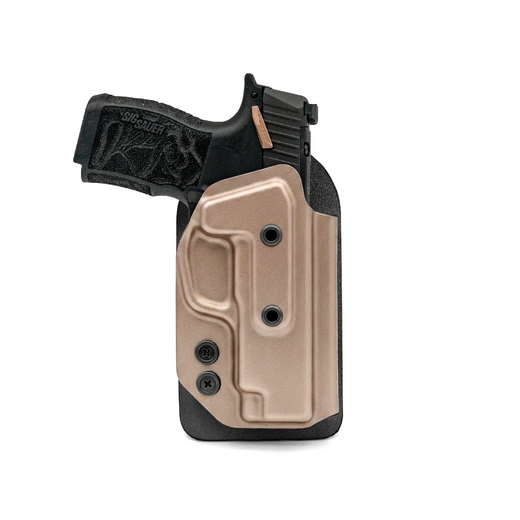
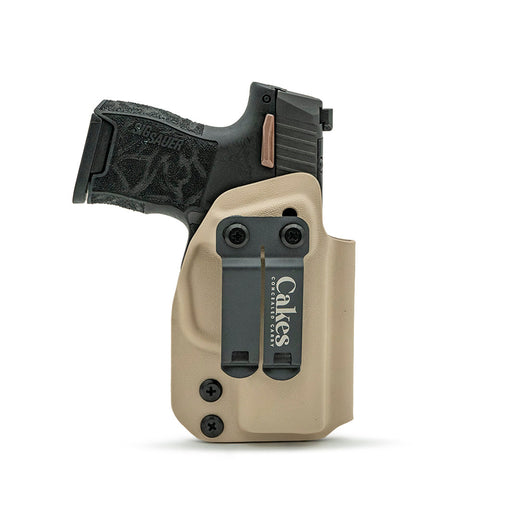
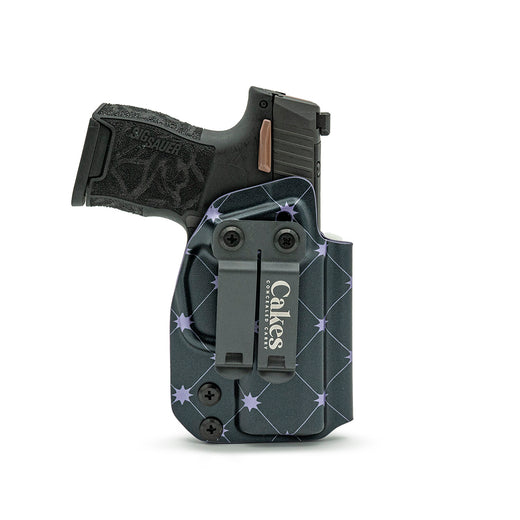
Holsters are a separate decision. For bag-only carry, Cakes makes a purse holster designed specifically for use inside a bag: the Cakes Purse Attachment Kydex Holster: Metallic has an industrial-grade hook and loop backer that locks into any Cakes bag or any loop-lined purse and holds your angle through every draw. The purse holster is made for bag use only, so it does not go on your body. If you want one holster that works both ways, the holster collection lists IWB Kydex holsters that you can wear on your body or use inside a bag. Check each product page for fit with your model.


Set Up Your Crossbody Bag the Right Way
A good setup puts the gun compartment where your dominant hand can reach it, keeps the bag snug against your body and gives the firearm its own holster and pocket. Follow these steps in order the first time you load your bag.
- Wear the strap across your body. Never on one shoulder. The diagonal strap is where the retention advantage comes from.
- Pick your side and test it. Choose the position that lets your dominant hand reach the pull tab or zipper without crossing in front of your face or your support arm. Many carriers wear the bag at the front, slightly toward the support side; others prefer the strong-side hip. Try both with an instructor before you settle.
- Set the strap length. The bag should sit at or just above your hip. Too long and it swings and bumps; too short and you cannot open the compartment cleanly. The bags in the specs table list a maximum circumference of 55 in.
- Add a waist anchor if the bag moves. The Waist Belt for CCW Bags clips onto either D-ring on the sides of a Cakes bag and goes around your waist, which keeps the bag from swinging when you walk fast or bend over.
- Holster the firearm. Use a holster made for your exact model that fully covers the trigger guard, such as a Cakes purse attachment holster or an IWB Kydex holster. A loose gun in a pocket can shift, and objects can reach the trigger.
- Keep the gun compartment for the gun only. No keys, pens, lipstick or phone. Anything else in that pocket can snag on the draw or get into the trigger guard.
- Run a 10-second check before you leave. Compartment closed, strap snug, holster seated, bag on your body.
Practice the Draw With Your Unloaded Firearm
Practice is what makes a crossbody bag fast; the bag alone does not. Start with dry practice at home using your unloaded firearm, then confirm the skill with live-fire training under a qualified instructor.
Set up every dry session with your unloaded firearm
- Move all ammunition to a different room before you begin, then check your unloaded firearm twice: magazine out, chamber empty, by sight and by feel.
- Choose a safe direction, a wall or backstop that would stop a round, and keep the muzzle pointed there for the whole session.
- Keep your finger straight along the frame and off the trigger until the sights are on target.
- Re-holster slowly and look at the holster as you do it. Speed belongs to the draw, never to the re-holster.
- When the session ends, say out loud that dry practice with your unloaded firearm is over before you reload, so the routine has a clear finish.
Follow a 4-week practice plan with your unloaded firearm
| Week | Focus (dry, with your unloaded firearm) | Suggested reps | Goal |
|---|---|---|---|
| 1 | Open the compartment and establish your grip without drawing | 10 slow reps, 3 sessions | Find your grip without looking |
| 2 | Full draw to a ready position, then a slow re-holster | 10 reps, 3 sessions | One smooth motion out; careful motion back |
| 3 | Draw while standing, walking and seated | 10 reps per position, 2 sessions | Confirm the bag position works in real life |
| 4 | Repeat in the outfit you wear most, then book a live-fire session | 10 reps plus 1 range session | Confirm the skill under supervision |
Rep counts are a suggested starting point, not a published standard. Every dry rep uses your unloaded firearm.
If you carry a backpack, practice its full sequence too: strap off, swing, open, draw. Time a few dry reps with your unloaded firearm and a phone timer, then time the same reps from a crossbody. Your own numbers will tell you more about the trade-off than any article can.
For supervised training, the Cakes instructor directory lets you enter a zip code to find firearms instructors within 200 miles. The page says Cakes Certified instructors are vetted and certified by the Cakes team, and they appear first. National organizations such as USCCA also list classes. For more on building the habit, read Training the Draw: Why Practice Matters as Much as the Gear.
Fix the 6 Mistakes We See Most Often
Most problems with off-body carry come from habits, not from the bag. Each mistake below comes with a fix you can apply today.
- Setting the bag down. Fix: adopt one rule. The bag is on your body, in your hand or in locked storage; there is no fourth place.
- Wearing a crossbody on one shoulder. Fix: always run the strap across your torso. Shoulder carry gives up the retention that made you choose a crossbody.
- Sharing the gun compartment. Fix: keep that pocket empty except for the holstered firearm.
- Switching sides without practice. Fix: if your shoulder needs a break, either practice the draw from both sides with your unloaded firearm or move items out to lighten the bag.
- Buying a backpack without timing the access. Fix: run the strap-off, swing, open, draw sequence with your unloaded firearm before you decide it will work for daily carry.
- Choosing by looks before fit. Fix: run your make, model and setup through the Does It Fit? tool first, then choose color and material.
Match the Bag to Your Day
No single bag fits every situation, so plan by setting. Use this table as a starting point and adjust for your routine and your local law.
| Situation | Better choice | Why |
|---|---|---|
| Errands, work, dinner | Crossbody | Fast front access and a handbag look; stays on your body |
| Gym or athletic day | Crossbody in nylon, kept on your body or locked up | If you cannot keep it on you, the firearm needs secure storage |
| Commute with a laptop | Backpack for gear plus a crossbody for the firearm | Keeps capacity without putting the gun behind you |
| Hiking | Backpack for gear; firearm in a front-access option | Weight spreads across 2 shoulders while the gun stays reachable |
| Out with young children | Crossbody, never set down | You can see the bag while your hands are busy |
| Air travel | Neither in the cabin | Firearms are not allowed in carry-on bags on US flights; check TSA and airline rules for checked baggage |
Situational guidance as of October 2026. Laws and venue rules vary; check them before you go.
Lock It Up Whenever It Leaves Your Body
Off-body carry comes with one storage rule: when the bag is not on your body, the firearm goes into a locked container or safe. This matters most in a home with children or visitors.
A bag hung on a doorknob, dropped on a couch or left in a car is within reach of anyone who picks it up. Children are curious about bags because that is where snacks, phones and keys live. Make the transfer to a lockbox or safe part of your arrival routine, the same way you hang up your keys.
Project ChildSafe, a program of the National Shooting Sports Foundation, offers free gun locks and safety kits along with storage guidance for families. If you leave a firearm in a vehicle, check your state's rules on vehicle storage first; some states set specific requirements.
Check Your State's Carry Law Before You Choose
Carry laws vary by state and change often, so confirm the current rules before you carry in any bag. This section is general information, not legal advice.
Some states and many venues regulate where you may carry, how a firearm must be stored in a vehicle and how your state defines carrying a firearm on or about your person. Schools, government buildings, airports and private businesses can each have their own rules. Accuracy note: check your current state law and any local rules before you carry, and ask a certified instructor about your state's specifics.
FAQ: Crossbody vs Backpack Concealed Carry
Is a crossbody bag good for concealed carry?
Yes, for most daily carry. A crossbody concealed carry bag keeps the firearm in front of you, stays attached to your body and allows one-handed access. Choose one with a dedicated firearm compartment, a holster that covers the trigger guard and a strap that crosses your torso, then practice the draw with your unloaded firearm.
Is it safe to carry a gun in a backpack?
It can be, if the backpack has a dedicated compartment, the firearm is in a holster that covers the trigger guard and the pack stays under your control. The risks are slower access and the habit of setting the pack down. When it leaves your body, the firearm belongs in locked storage.
What is the difference between a sling bag and a crossbody bag?
Both use 1 diagonal strap across the torso. A crossbody rests at your hip or front, so the compartment stays within easy reach. A sling usually rides on your back or under your arm and must be rotated forward before you can open it, which adds a step to your draw.
Is off-body carry legal in every state?
Rules differ by state, and some states and venues limit where and how you may carry or store a firearm, including in a vehicle. Check your current state law and local rules, and ask a certified instructor about your state. This answer is general information, not legal advice.
How do I keep a crossbody concealed carry bag from being snatched?
Wear the strap across your torso, never on one shoulder, and keep the bag at your front or hip where you can see it. Do not hang it on chairs or set it in carts. If the bag shifts, a waist anchor that clips to the side D-rings holds it closer to your body.