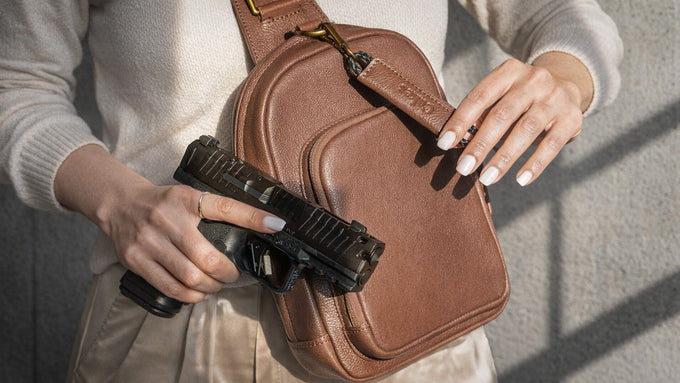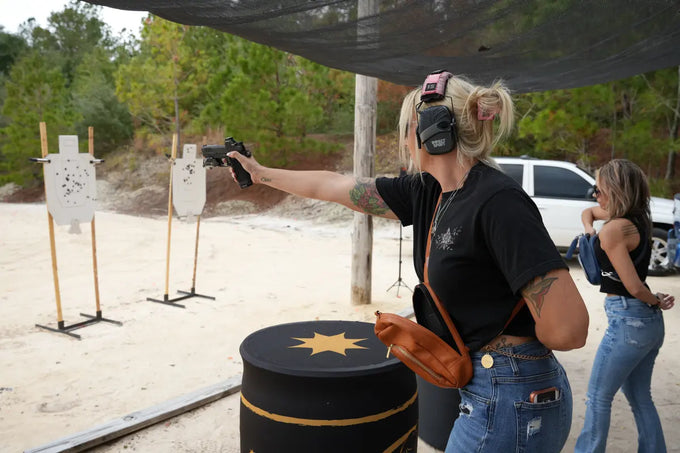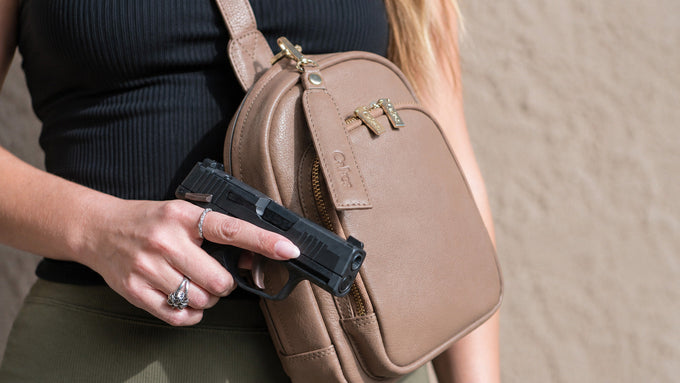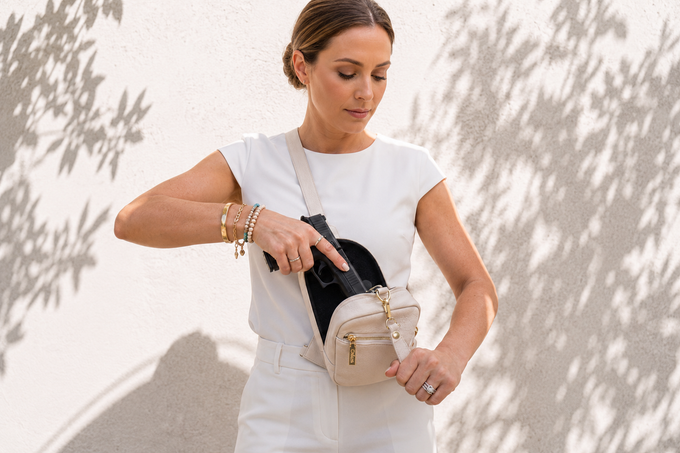

More women are carrying a firearm for self-defense every year, and more of them are choosing to carry it off-body in a purse, crossbody bag, or fanny pack rather than in a waistband holster. That shift is real, and it is worth understanding. But at Cakes Concealed Carry, we will not talk about off-body carry self-defense movement as a fashion trend before we talk about it as a safety decision. A carry method is only as good as the training and the equipment discipline behind it. This article walks through the female self-defense movement toward off-body carry for women, why it is growing, what safety requirements come first, and how to evaluate an off-body bag with the same rigor you would apply to a holster on your hip.
Arming readers with information is part of the product we make. A sale is not the measure of success. If you finish this article and decide off-body carry is not right for you, that is a good outcome too, as long as you carry your firearm safely and train with it regularly.
The reasons women give for choosing off-body carry are usually practical rather than trend-driven. Many report that certain clothing, particularly form-fitting or lightweight fabric, does not conceal a waistband holster well. Others carry off-body during pregnancy or after surgery, when a belt holster is uncomfortable or medically inadvisable. Some simply find that a well-built bag with a dedicated holster compartment gives them a faster, more comfortable draw than an inside-the-waistband holster does for their body type. None of those reasons removes the safety and training requirements below. They are the reasons the method exists, not a substitute for doing the work of carrying it correctly.
Start With Safety
Off-body carry introduces a specific safety variable that on-body carry does not: the firearm is no longer physically attached to you. Your bag can be set down, handed to someone else at a coat check, grabbed by a stranger, or separated from you in a crowd. Every safety requirement below exists because of that separation.
Follow the safety hierarchy in this order: safety first, training second, mindset third, equipment last. Do not reverse that order because a bag looks good or matches an outfit.
This hierarchy matters more with off-body carry than with almost any other carry method, because the equipment failure modes are different. A holster on your hip can loosen, but it rarely leaves your side without you noticing immediately. A bag can be set on a table, looped over the back of a chair, or handed off for a few seconds without a second thought. None of those moments are dangerous by themselves. They become dangerous only when the person carrying has not thought through what has to be true about that bag at all times for it to stay safe.
- The firearm must stay in a dedicated, rigid holster compartment inside the bag at all times, never loose against other contents.
- The trigger guard must be fully covered by that holster whenever the firearm is holstered.
- The bag itself must never leave your physical control while it contains a loaded firearm. If you would not hand a stranger your holstered firearm directly, do not hand them the bag either.
- Secure storage is non-negotiable the moment that bag comes off your body, particularly in a home with children. Before you bring a firearm into a household with kids, review Project ChildSafe's storage guidance and apply it to wherever the bag lives when you are not wearing it, not just to a safe in a closet.
Training Before Equipment
Off-body carry changes your draw. You are not pulling from a fixed position on your hip. You are locating the firearm inside a bag that may have shifted, opening a compartment, and drawing from an angle that changes depending on how you are standing or sitting. That is a distinct skill, and it has to be trained, not assumed.
Before you carry a loaded off-body bag in public, practice the full draw sequence using an unloaded, verified-clear firearm. Confirm the chamber is empty and the magazine is removed, following your firearm's manufacturer safety instructions, before you touch the trigger or manipulate the slide in any dry-fire or draw practice.
- Practice locating the holster compartment by feel, with the bag in different positions (crossbody, on a chair back, on your lap), using your unloaded, verified-clear firearm only.
- Practice drawing while seated, while standing, and while holding something in your other hand, always starting from an unloaded, verified-clear firearm.
- Once dry-fire fundamentals are solid, move to live-fire training at a range under qualified instruction before carrying that method in public.
A qualified instructor should evaluate your off-body draw before you rely on it. You can find one through the Cakes Concealed Carry Instructor Map or through USCCA's Training Resources.
What You Should Test
Do not take a bag's marketing at face value. Run these checks yourself before you trust it with a loaded firearm. Each test below tells you something specific and measurable. None of them require special equipment, and all of them should be repeated any time you switch to a new bag, a new firearm model, or a new holster insert, since a passing result with one combination does not guarantee a passing result with another.
The Silhouette Test
With the bag worn as intended and the holster insert in place, look at yourself in a mirror from multiple angles. A visible outline or an unnatural bulge tells other people there may be a firearm present. Adjust the insert position or bag style until the profile reads as an ordinary bag.
The Retention Check
With an unloaded, verified-clear firearm seated in the holster insert, turn the bag upside down and shake it firmly. The firearm should not move or fall free. If it shifts at all, the retention is inadequate for carry.
The Controlled Tug Test
Have a training partner attempt to pull the bag away from you while you hold the strap, in a controlled setting with an unloaded, verified-clear firearm inside. This tells you how the strap, hardware, and your own grip respond under a realistic grab, which is the exact scenario off-body carry has to withstand.
The Timed Draw Test
Using an unloaded, verified-clear firearm, time yourself drawing from the bag in a few realistic positions. Compare that time against your on-body draw. If off-body carry adds significant time, that is information you need before you decide this is your primary method, not a reason to hide the result from yourself.
Why the Tueller Drill Is Relevant to the Timed Draw Test
You may see the Tueller Drill referenced in self-defense discussions, often shortened to the “21-foot rule.” It originated with Salt Lake City police Lieutenant and firearms instructor Dennis Tueller, who examined how quickly a person armed with an edged weapon could close a distance of approximately 21 feet. The exercise became an important training reference because it demonstrates a simple point: distance does not automatically equal time.
That is why it matters when we talk about timed draw tests. The purpose is not to suggest that 21 feet is a magic number or that reaching a firearm within a certain number of seconds guarantees a successful defensive outcome. It doesn’t. Real encounters can involve different distances, obstacles, terrain, multiple attackers, distractions, an unaware defender, or a firearm that is not immediately accessible. The Tueller Drill was never intended to predict exactly how a specific defensive encounter will unfold.
Instead, use it as a reminder of why access time matters. If your firearm is carried inside a purse, backpack, crossbody bag, or other off-body system, you need to know how long it realistically takes you to access and draw it—not just when standing comfortably on a range, but from the positions in which you actually carry it. Your timed draw test gives you information about your own equipment, carry method, and abilities. The goal isn’t to beat someone else’s time; it’s to understand your time so you can make informed decisions about your personal-defense setup.
Safety Non-Negotiables
These features are not preferences. If a bag does not meet these, it does not belong on your body with a loaded firearm inside it.
- A rigid, dedicated holster compartment molded or fitted for your specific firearm model, not a soft pocket the gun floats inside.
- Full trigger guard coverage from the holster insert itself, verified with the retention check above using an unloaded, verified-clear firearm.
- Retention that survives the controlled tug test and the upside-down shake without the firearm shifting position.
- A compartment that separates the firearm from keys, phones, pens, or anything else that could enter the trigger guard area.
Nice-to-Have Features
These improve day-to-day usability. They matter, but they do not replace anything above.
- Ambidextrous carry options so the bag works whether you draw with your left or right hand.
- Additional organizational pockets for a wallet, phone, or keys, separate from the firearm compartment.
- Color and material choices that fit your wardrobe rather than reading as tactical gear.
- Adjustable strap length for wearing the bag crossbody, on one shoulder, or as a belt bag.
How Cakes Concealed Carry Approaches Off-Body Carry
We design our off-body carry bags around the safety non-negotiables above first. Our approach starts with a rigid holster insert, not a soft pocket, and we build the surrounding bag so the insert stays in a fixed, predictable position during normal wear. We also point customers to our Does It Fit checker before they buy, because a bag that does not fit your specific firearm model correctly cannot meet the retention and trigger coverage standards we require.
We also build with the assumption that the bag will be judged first as a bag and second as a carry system. That is not a marketing preference. If a bag reads as tactical gear, it draws attention, and drawing attention defeats part of the purpose of choosing off-body carry in the first place for many women. So the safety non-negotiables above are treated as the floor, not the ceiling, and the design decisions on top of that floor are about making the bag work as something you would carry regardless of what is inside it.
Training and Safety Resources
Use these resources alongside this article, not instead of it.
- Find a qualified instructor near you through the Cakes Concealed Carry instructor map.
- Review USCCA's training and education resources for structured concealed carry instruction.
- Review Project ChildSafe's secure storage guidance before bringing a firearm into a home with children.
Carry laws, permit requirements, and storage regulations vary by state and change over time. This article is not legal advice. Confirm current requirements with your state or local licensing authority before you carry.
Common Questions About Off-Body Carry
Is off-body carry less safe than on-body carry?
Off-body carry is not inherently less safe, but it removes a margin of error that on-body carry provides by default. On your hip, the firearm is under your direct physical control unless someone attacks you specifically to take it. In a bag, the firearm is under your control only as long as you actively maintain control of that bag. The method is not the deciding factor. Your discipline in maintaining physical control of the bag, and your training on the draw, are what determine whether off-body carry is safe for you specifically.
Can I switch between on-body and off-body carry?
Many women do, choosing on-body carry for some outfits or situations and an off-body bag for others, such as when clothing does not accommodate a waistband holster. If you carry both ways, you need to be equally practiced at the draw for each, using an unloaded, verified-clear firearm for all practice repetitions. Do not assume competence with one method transfers automatically to the other.
What if I do not want a firearm-specific bag?
A bag without a dedicated, rigid holster compartment does not meet the safety non-negotiables described above, regardless of how well made it is otherwise. If a bag was not designed for carry, do not adapt it by placing a loose holster or an unholstered firearm inside a standard interior pocket. The trigger guard coverage and retention requirements are not optional conveniences. They are the difference between a bag that carries a firearm safely and a bag that simply contains one.
Practical Next Step
Before you carry a loaded firearm in an off-body bag, run the silhouette test, the retention check, the controlled tug test, and the timed draw test yourself, using an unloaded, verified-clear firearm for every step that involves handling. Then confirm fit with the Does It Fit checker and, if you have not already, schedule time with a qualified instructor through the Cakes Concealed Carry instructor map to have your off-body draw evaluated directly.