
If you are working out how to choose a concealed carry purse, shop in stages. Confirm your firearm and holster fit the gun compartment with room to draw, read the listing for a dedicated compartment and a one-handed closure, test the crossbody strap on your body, buy locked storage with the bag, then rehearse the draw before daily carry.
Most buying advice arrives as a ranked list of bags. This walkthrough follows the order a purchase actually happens instead: the homework before you browse, the details to read on a listing, the tests to run when the bag is in your hands, the extras to add at checkout and the habits to build in the first week. Each stage has its own checkpoints, and a printable checklist at the end pulls them together.
It works for any brand. Where we use Cakes bags as examples, the details come from the live product pages, and where a page is silent or two pages disagree, we leave the claim out rather than guess.
Before You Shop
Before you open a single product page, know your firearm's exact setup and how you plan to wear the bag. Those 2 facts rule out more bags than color, leather or price ever will.
Shoppers often start with looks and work backward to fit. That order leads to returns, or worse, to a bag that almost works and gets carried anyway. A few minutes of homework turns every listing you read later into a quick yes or no.
Checkpoint: Write Down Your Exact Firearm Setup
Note the make and model of the firearm you plan to carry, then list everything attached to it. An optic, a weapon-mounted light and an extended magazine each change the space the gun needs, and so does the holster itself.
The Does It Fit? tool on the Cakes site turns that list into numbers. You pick your make and model, which fills in the length and frame height, and then you add your setup. On the tool, a Kydex holster "Adds 0.5" to height," an optic "Adds 0.5" to height," an extended magazine "Adds 1.5" to height" and a weapon-mounted light "Adds 1" to length."
Write your setup down exactly as you carry it, not as you wish you carried it. If the light stays on the gun every day, it goes on the list.
Checkpoint: Learn the 2 Fit Rules
The tool applies 2 rules, quoted here exactly. The first: "Firearm + Holster Length must be 0.5 in less than the bag's internal height." The second: "Frame Height + Optic must be at least 0.5 in shorter than the bag's internal width to allow clean draw and re-holstering."
In plain terms, the gun needs a margin on every side so your hand can get around the grip and the muzzle can clear the holster without snagging. A gun that only just fits is a gun you will fight with when you need it fast.
Hypothetical example: say your pistol in a holster is 7 in long. The first rule points you to a bag with at least 7.5 in of internal height. Add a weapon-mounted light, which adds 1 in to length on the tool, and the requirement becomes 8.5 in. One accessory can push you from a compact bag into a larger one, which is why the setup list comes first.
Checkpoint: Take Your Own Measurements Safely
If you want to confirm the numbers yourself, measure only an unloaded, verified-clear firearm. Remove the magazine, lock the slide back, look into the chamber and feel it with a finger to verify that it is empty, close the slide, and move all ammunition to a different room before the tape measure comes out.
Lay your unloaded firearm on a table with the muzzle pointed at a wall that would stop a round, and keep your finger off the trigger. Measure overall length and frame height, then add the holster figure. Compare your numbers with the tool, and if they disagree, trust the larger number.
Checkpoint: Decide How You Will Wear the Bag
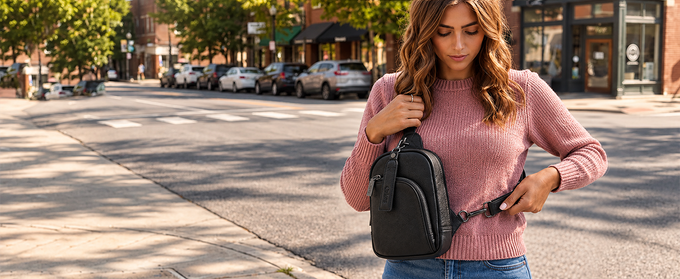
A crossbody strap runs from one shoulder diagonally across your chest to the opposite hip. For carry, that position does 2 jobs. It keeps the bag in front of you where your dominant hand can reach it, and it makes the bag hard to pull away, because a strap across your torso has to be lifted over your head or cut.
That second job has a name: retention, meaning your control over the bag and the firearm inside it. A bag that hangs from one shoulder or swings from your hand gives up most of it. Decide now that the carry bag will be worn crossbody, and screen out any listing that offers only a shoulder strap or a top handle.
Checkpoint: Pick Leather or Nylon for Your Real Week
Think about the places you go most often, not the occasions you dress up for. A leather bag reads as a classic handbag and suits an office or a dinner. A nylon bag reads as athletic or travel gear and suits the gym, trails and errands. A bag that looks out of place gets left at home, and a carry bag left at home does nothing.
If you are torn, choose for the 5 weekdays rather than the weekend. Style still matters, and the Cakes article Trendy Concealed Carry Bags in 2026: Stylish Bags That Carry Safely covers it, but treats style as a tiebreaker after fit and wear are settled.
On the Product Page
On the listing, read for evidence rather than adjectives. You are looking for a dedicated firearm compartment, a closure described in enough detail to judge, a strap length you can compare with your body, and dimensions you can test against the fit rules.
A listing that leaves these out may still describe a good bag, but you cannot know that from the page. When the details are missing, ask the seller before you buy, and keep the answer in writing.
Checkpoint: Find a Dedicated Firearm Compartment
A dedicated firearm compartment is a pocket that holds the holstered gun and nothing else, separate from your phone, keys and wallet. If you remember 1 answer to what to look for in a CCW purse, make it this one. Loose items such as pens, keys or a lipstick tube can work into a trigger guard, and clutter can catch the grip on the way out.
Look for the words on the page. The Millie Athletic Compact-M page lists a "Dedicated firearm compartment," and the Millie Athletic XL-M page lists a "Separate firearm compartment." The Madeline XL-M page describes "Space for a holster along the inside back of the bag," which places the gun on the side that rests against your body.
Checkpoint: Read Exactly How the Closure Opens
The closure decides how fast and how quietly the compartment opens, and whether you can do it with 1 hand while your other hand holds a door, a phone or a child. Read the description for the mechanism, not just the word "secure."
Both Madeline bags describe a magnetic closure with a pull tab. The Madeline Compact-M page describes a "magnetic closure and unique pull-tab" that "you simply pull down for immediate access." The Madeline XL-M page says the tab "is attached to a magnetic closure" and cites "N45-strength neodymium magnetic force that ensures your main CCW compartment stays closed throughout the day." The Millie Athletic XL-M page lists "Magnetic pull tab access."
Many bags from other brands close the gun compartment with a zipper. A zipper is secure, but it often needs a steadying hand, and the pull can be hard to find by feel. Neither design is automatically wrong. Note what the listing says now, because you will test it in Stage 3.
Checkpoint: Compare the Strap Length With Your Body
Run a soft tape measure from one shoulder, across your chest, to the opposite hip and back up to the shoulder. That loop is roughly the circumference the strap has to reach with the bag sitting at your hip. Add room for a winter coat if you carry year round.
Then compare it with the listing. The Madeline XL-M page lists a strap "Adjustable up to 49 inches, with a maximum circumference of 55 inches." The Millie Athletic pages list a strap adjustable to 49 in with a circumference of 55 in, and the Madeline Compact-M page lists a "Maximum circumference of 55”." The Madeline Compact-M page also describes a "hands-free crossbody option and a handheld purse"; for carry, the crossbody setting is the one that keeps the bag on you.
Checkpoint: Treat Listed Dimensions as a Starting Point
Product pages usually list outside dimensions and do not label them as internal. Leather, lining and the compartment wall all take up space, so the interior is smaller than the numbers suggest. Use the listed size to narrow the field, and use the fit tool for the final answer.
Here is how the 4 current Madeline and Millie Athletic crossbody bags read on their product pages. The 2 lines cover leather and nylon, with a Compact-M and an XL-M size in each. Click a bag name to open its page, or browse the full CCW bags collection for every current style.
| Bag | Material | Dimensions (as listed) | Strap | Gun compartment access | Price |
|---|---|---|---|---|---|
| Madeline XL-M | 100% naturally milled cow hide leather | 6.6 in W x 9 in H x 2.16 in D | Adjustable up to 49 in, max circumference 55 in | Pull tab attached to a magnetic closure | $205 |
| Madeline Compact-M | 100% naturally milled cow hide leather | 5.6 in W x 8 in H x 2.16 in D | Max circumference 55 in | Magnetic closure and pull tab | $185 |
| Millie Athletic XL-M Nylon CCW Bag | Nylon | 6.7 in x 9 in x 2 in | Adjustable to 49 in, max circumference 55 in | Magnetic pull tab access | $190 |
| Millie Athletic Compact-M Nylon CCW Bag | Nylon | 5.7 in x 7.8 in x 2 in | Adjustable to 49 in, circumference 55 in | Dedicated firearm compartment (see page for details) | $175 |
Bag details as of October 2026, as listed on each product page. Prices as of October 2026 (USD); prices change, so confirm on the product page.
Read the table in pairs. The Madeline XL-M and Madeline Compact-M share the same leather and depth, and the XL-M is 1 in wider and 1 in taller as listed. The 2 Millie Athletic bags follow the same pattern in nylon. If the fit tool passes your setup in both sizes, the smaller bag is less to wear all day; if it passes only in the larger one, the decision is made for you.
Checkpoint: See What the Listing Says About Holsters
A holster made for your exact model is part of the setup, so read each product page for what it says about holsters before you order, and plan for what you still need to add. The holster collection lists Kydex holsters labeled for bag use and describes purse holsters that "attach directly into your Cakes bag with a hook and loop back panel."
Checkpoint: Note the Red Flags on Any Listing
Some phrases should slow you down. "Fits most handguns" with no dimensions tells you nothing. An open slip pocket inside the main space is not a firearm compartment. A shoulder strap with no crossbody option gives up retention. A closure that is never described leaves you guessing about access.
For a fuller list of concealed carry purse features to confirm on any brand's listing, the older Cakes article 10 Features Every Concealed Carry Handbag Should Have goes feature by feature.
With the Bag in Your Hands
When the bag arrives, test it empty first, then with your holstered, unloaded firearm, before you commit to it for daily carry. Paper specs tell you whether a bag can work; these checks tell you whether it works for you.
Run every test that puts the gun in the bag in a room with no ammunition in it, with your unloaded firearm confirmed clear by sight and by feel, and with the muzzle kept toward a safe direction whenever the gun is out of the holster.
Checkpoint: Inspect the Empty Compartment
Open the gun compartment and run your hand around the inside. Note where the holster will sit, how deep the pocket is, and whether any seam, zipper track or lining edge could catch a front sight. On the Madeline XL-M, the page describes the holster space along the inside back of the bag, so check that the back panel is flat and firm.
Then close the compartment and shake the bag gently. A good closure stays shut, and the compartment holds its shape instead of collapsing inward.
Checkpoint: Set the Strap Height on Your Body
Put the bag on crossbody and adjust the strap until the bag rests at or just above your hip on the side of your dominant hand, or slightly forward of it. Too long, and the bag bumps your thigh and swings as you walk. Too short, and your wrist has to bend sharply to reach the opening.
Walk around the house for a few minutes. Climb stairs, open a door, bend to pick something up. Note where the bag drifts, because that drift is where the gun will be when you reach for it.
Checkpoint: Open the Compartment by Feel
With the bag on and empty, look straight ahead and open the gun compartment with your dominant hand alone. Then close it by feel. Repeat until you can do it without a glance and without steadying the bag with your other hand.
If the closure needs 2 hands every time, or you keep looking down to find the tab or zipper pull, the bag fails this checkpoint. That extra motion would become part of every draw you ever make from it.
Checkpoint: Seat Your Holster and Check the Trigger Guard
Install the holster in the compartment, then seat your unloaded firearm in it. The holster should cover the full trigger guard on both sides and hold the gun at the same angle every time. A rigid material such as Kydex keeps the holster mouth open, which matters when you put the gun back.
Give the grip a slow, gentle pull with your unloaded firearm in place. The gun should leave the holster while the holster stays in the bag. If the holster comes out with the gun, it is not anchored well enough for carry.
Checkpoint: Look for Printing in a Mirror
Printing means the outline of the firearm showing through the bag. With your holstered, unloaded firearm inside, stand in front of a mirror and look from the front, from the side and from behind. Check again while seated, since a bag in your lap shows its contents differently.
A stiffer material and a defined compartment both reduce printing. If the outline shows clearly, try wearing the bag slightly further back, and if that does not solve it, the bag is probably the wrong size or shape for your gun.
Checkpoint: Sit, Walk and Drive With It
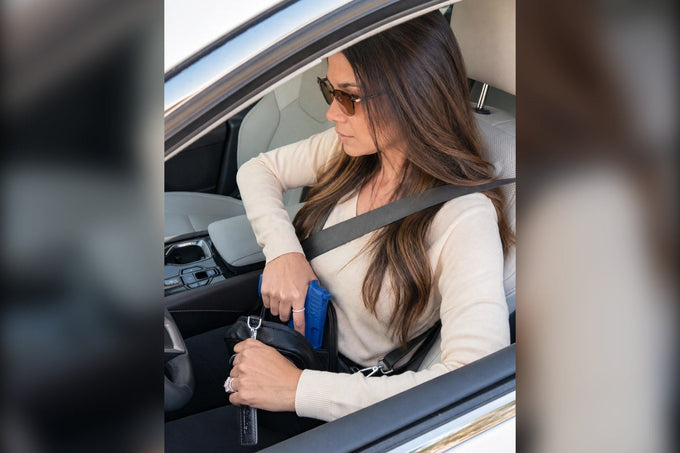
Wear the bag with your unloaded firearm through a normal hour at home. Sit in a dining chair, sit on the couch, and if you can do so safely and legally, sit in the driver's seat of a parked car with the seat belt on. In each position, ask 1 question: can I still reach the compartment opening with my dominant hand?
A seat belt often crosses the same line as a crossbody strap, and a car seat pushes the bag toward the center console. Knowing that now helps you decide where the bag sits when you drive, before you are in traffic.
At Checkout
Checkout is where you add what the bag needs to work safely: a holster made for your exact model, a way to steady the bag if it swings, and locked storage for every place the bag comes off your body. It is also the right moment to confirm the law where you live.
Checkpoint: Add a Holster Made for Your Exact Model
Every firearm in a bag belongs in a holster molded for that exact make and model, including any optic or light, that fully covers the trigger guard. Choose it now so the bag and holster arrive together and you test them as a pair. Browse the holster collection and remember the fit tool counts a Kydex holster as adding 0.5 in to height.
Checkpoint: Consider a Waist Anchor
If your Stage 3 walk showed the bag swinging away from your hand, a waist anchor can help. The Waist Belt for CCW Bags is described on its page as metal waist chains "designed to clip onto your Cakes Concealed Carry™ purse around your waist," and it attaches to either D-ring on the sides of the bag. Measure your waist and confirm sizing on the product page before you order.
Checkpoint: Buy Locked Storage in the Same Order
A carry bag comes off your body many times a day, and every time it does, the firearm needs a locked home. Buy or set up a lockbox or gun safe at the same time as the bag, so there is never a first night when the bag ends up on a chair with the gun inside.
Children are drawn to bags, because that is where phones, snacks and keys live. A bag hung on a doorknob or dropped on a couch is within reach of anyone who picks it up, including a visiting child or a guest. Plan a lockbox at home, a second one where you spend long stretches such as an office, and a vehicle option only where your state allows it.
Project ChildSafe, run by the National Shooting Sports Foundation, gives out free gun locks and safety kits along with storage guidance for families. A cable lock is not a substitute for a lockbox when the gun leaves your body, but it adds a layer when the gun is stored.
Checkpoint: Confirm Your State Law Before the Bag Ships
Carry laws vary by state and change often. Before the bag arrives, check your current state law on carrying a concealed firearm, on carrying it in a bag rather than on your body, and on storing it in a vehicle. Schools, government buildings, airports and many private businesses set their own rules as well.
Firearms are not allowed in carry-on bags on US flights, so a carry bag never goes through airport screening with a gun inside. The firearm must be declared at the ticket counter and placed in a TSA approved lock box with the ammunition stored separately in your checked bag. Accuracy note: this section is general information, not legal advice; check your current state law and local rules before you carry, and ask a certified instructor about your state's specifics. A helpful guide for state laws and for traveling with a firearm is the USCCA Reciprocity App.
Checkpoint: Read Your Cart One More Time
Before you pay, compare the cart with your Stage 1 notes. The bag size should match your fit tool result for your full setup. The holster should match your exact model. The lockbox should be in the cart or already at home. If any of those is missing, wait.
We sell bags, so we have an interest in what you buy. We also think that helping you judge a bag well is part of what we make, and a sale is not the measure of whether this walkthrough worked. If no bag on our site passes your checkpoints, buy the one that does.
Shoppers searching for the best concealed carry purse usually find there is no single winner. The best one for you is the bag that passes the fit test for your setup, opens with 1 hand and stays on your body, in a material you will wear every day.
The First Week You Own It
The first week turns a purchase into a carry setup. Rehearse the draw at home with your unloaded firearm, make the lockbox transfer a habit, and book supervised training before you rely on the bag.
Checkpoint: Set Up a Safe Space for Dry Rehearsal
Pick 1 room for dry rehearsal and keep it the same all week. Move every round of ammunition to a different room. Check your unloaded firearm twice, magazine out and chamber empty, by sight and by feel, every time you start.
Choose a safe direction, a wall or backstop that would stop a round, and keep the muzzle pointed there for the whole session with your unloaded firearm. Keep your finger straight along the frame and off the trigger until your sights are on the target.
Checkpoint: Rehearse the Draw From 3 Positions
Start standing. Open the compartment by feel, establish a full grip, draw your unloaded firearm to a ready position, then pause. Slow, correct repetitions build the path your hand will follow later; speed comes on its own once the motion is consistent.
Next, rehearse with your unloaded firearm while taking a few slow steps, which shows whether the bag swings away from your hand. Finish seated in a chair, which shows whether the bag still sits where you can reach it. If any position fails, adjust the strap or the side you wear the bag on, and repeat with your unloaded firearm.
Checkpoint: Re-Holster Slowly, Every Time
Putting the gun back is where many accidents happen, so treat it as its own skill. Look at the holster as you re-holster your unloaded firearm, keep your finger out of the trigger guard and on the frame, and make sure nothing (a strap, a lining edge, a corner of fabric) has folded into the holster mouth.
Go fast on the draw if you like; go slow on the way back into the holster. When the dry session with your unloaded firearm ends, say so out loud before you reload, so the routine has a clear finish and nobody in the house is unsure of the gun's status.
Checkpoint: Make the Lockbox Transfer Automatic
Pair the transfer with something you already do on arrival, such as hanging up your keys. Bag comes off, gun goes into the lockbox, lockbox closes, then you put the bag down. Do it the same way every day this week until you no longer think about it.
Walk through your week and name each place the bag comes off: the front hall, the office, the gym locker, a friend's house. If any place has no locked option, the bag stays on your body there or the gun stays locked at home.
Checkpoint: Book Training With an Instructor
Dry rehearsal at home builds familiarity, and live-fire training confirms it under supervision. The Cakes instructor directory lets you enter a zip code to find firearms instructors within 200 miles, and the page says Cakes Certified instructors are vetted and certified by the Cakes team and appear first. Bring the bag you bought, not a loaner, so the drills match your real setup.
For more on why the repetitions with your unloaded firearm matter, read Training the Draw: Why Practice Matters as Much as the Gear.
Checkpoint: Note What Still Bothers You
At the end of the week, write down anything that still feels off: a strap that slips, a tab you sometimes miss, a seat where the bag ends up behind you. Small fixes such as a strap adjustment or a waist anchor solve most of these. A bag that still fails fit or one-handed access after a week of adjustments is the wrong bag, however much you like the look.
Your Printable Checklist for How to Choose a Concealed Carry Purse
Here is how to choose a concealed carry purse on 1 page, stage by stage. Print it, or keep it open on your phone while you shop, and tick each box before you move to the next stage.
| Stage | Checkpoint | Done |
|---|---|---|
| 1. Before you shop | Make, model, optic, light, magazine and holster written down exactly as carried | [ ] |
| 1. Before you shop | Does It Fit? tool run for the full setup; both fit rules understood | [ ] |
| 1. Before you shop | Any measuring done only with an unloaded firearm, finger off the trigger | [ ] |
| 1. Before you shop | Crossbody carry decided; leather or nylon chosen for your real week | [ ] |
| 2. Product page | Dedicated firearm compartment named on the page | [ ] |
| 2. Product page | Closure mechanism described clearly enough to judge | [ ] |
| 2. Product page | Strap length compared with your own shoulder to hip loop | [ ] |
| 2. Product page | Size confirmed by the fit tool, not by listed outside dimensions alone | [ ] |
| 3. Bag in hand | Compartment opens and closes with 1 hand, by feel | [ ] |
| 3. Bag in hand | Bag rests at or just above your hip; no big swing when walking | [ ] |
| 3. Bag in hand | Holster covers the trigger guard and stays in the bag on a slow pull | [ ] |
| 3. Bag in hand | No obvious printing in the mirror, standing or seated | [ ] |
| 4. Checkout | Holster molded for your exact model in the cart | [ ] |
| 4. Checkout | Lockbox or safe for every place the bag comes off | [ ] |
| 4. Checkout | Current state law and venue rules checked | [ ] |
| 5. First week | Dry rehearsal standing, walking and seated with your unloaded firearm | [ ] |
| 5. First week | Slow, watched re-holster every time | [ ] |
| 5. First week | Lockbox transfer tied to your arrival routine | [ ] |
| 5. First week | Live-fire session booked with an instructor | [ ] |
Printable shopping checklist as of October 2026. Applies to any brand of carry bag.
If a bag fails a box in Stage 2 or Stage 3, go back a stage rather than forward. A bag that clears every box is the right bag for you, whatever the brand.
FAQ: How to Choose a Concealed Carry Purse
What should I look for in a concealed carry purse?
Look for an interior that fits your firearm and holster with room to draw, a dedicated firearm compartment, a closure you can open with 1 hand and an adjustable crossbody strap. Add a holster molded for your model that covers the trigger guard, and plan where the gun goes into locked storage when the bag comes off.
What is the best concealed carry purse?
The best concealed carry purse is the one that passes fit for your exact firearm and setup, opens with 1 hand and stays on your body with a crossbody strap. Run your make and model through a fit tool first, then choose leather or nylon for your week, and rehearse the draw with your unloaded firearm.
Can I carry a gun in a regular purse?
A regular purse lacks a dedicated compartment, so the gun shares space with keys, pens and other items that can reach the trigger guard. If you carry in a bag, choose one with a separate firearm compartment and a holster molded for your model that covers the trigger guard, worn crossbody and kept on your body.
Is it legal to carry a gun in a purse?
It depends on your state and where you are going. Some states and venues limit where and how you may carry or store a firearm, including in a vehicle. Check your current state law and local rules, and ask a certified instructor about your state's specifics. This answer is general information, not legal advice.
Next Step: Run Your Fit Check Before You Browse
Enter your make, model and full setup in the Does It Fit? tool to see which bag sizes pass for your firearm. Then open the Madeline XL-M or Madeline Compact-M pages, or every style in the CCW bags collection, with your printed checklist beside you.