
Key Takeaways:
A concealed carry handbag is not an accessory. It is a carry system, and it deserves the same scrutiny you would give a holster, a training class, or the firearm itself. When you carry off-body, the bag becomes the platform your entire defensive plan runs on. If the platform is weak, everything built on top of it is weak too.
At Cakes Concealed Carry, we design in a specific order: the firearm comes first, and the bag is built around it. That is the opposite of how most of the market works. A typical fashion bag with a "CCW pocket" starts as a handbag, and the firearm accommodation gets bolted on at the end, usually as a soft sleeve and a strip of hook-and-loop. The result looks like concealed carry but does not function like it. A true concealed carry handbag is engineered from the holster outward, and it is why female firearms instructors around the USA recommend Cakes Concealed Carry bags to their students by name.
But there is a second truth that matters just as much, and the industry talks about it far less. The best concealed carry purse for women is the one you will actually carry every single day. A bag that is uncomfortable, ugly, heavy, or impractical gets left in the closet, and a firearm sitting at home protects no one. Safety features you never carry are not safety features. They are shelf decorations.
So this list is built on both theses at once. Safety and fast access come first and are non-negotiable. Everyday beauty, comfort, and practicality come next, because they determine whether the safety features ever leave the house with you. A serious CCW bag has to win on both fronts, and the best ones live exactly at that intersection.
One more thing before we start: this list is ranked in order of priority, and the ranking is the point. The first 7 features are safety and access fundamentals. Treat them as a pass/fail gate, because a bag that fails any one of them fails as a carry system no matter how gorgeous it is. The last 3 separate good bags from great ones. If you are a first-time buyer, use Features 1 through 7 as your filter before you even look at colors. If you are upgrading from a bag that never quite worked, this list will probably show you exactly where your last bag failed you.
The Non-Negotiables: Safety and Access
These 7 features are the gate. A bag that fails any one of them fails as a carry system, full stop.
Feature 1: A Real Kydex Holster, Molded to Your Specific Firearm
Start here, because everything else depends on it: a loose pocket is not a holster. A soft sleeve is not a holster. A padded divider with some elastic is not a holster. If your firearm can shift, rotate, or present its trigger to anything other than your deliberate finger, you do not have a carry system. You have a gun loose in a bag.
The standard for off-body carry is a rigid Kydex holster. Kydex is a thermoplastic that is heat-formed under pressure to the exact contours of one firearm. That last part matters more than most buyers realize. A holster molded to your specific make and model locks onto the shape of your slide, your frame, and your trigger guard. A generic "fits any compact" sleeve cannot do that, because it is designed to sort of fit everything, which means it precisely fits nothing. Universal sleeves can leave part of the trigger guard exposed, allow the gun to settle at odd angles, and collapse when the gun comes out. Molded Kydex cannot, because it physically only accepts one silhouette.
A real holster does 4 jobs every time you reach for it. It orients the grip the same way on every draw, so your hand lands in a firing grip without fishing around. It holds the firearm in one fixed position no matter how the bag moves through your day. It covers the trigger guard completely, so nothing, not a pen, not a key, not a fingertip, can reach the trigger. And it releases cleanly on a deliberate draw, with no snagging and no drag.
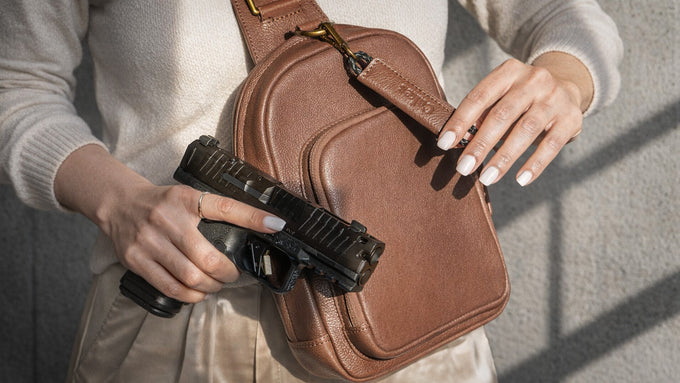
Here is where a well-engineered bag earns its keep: it should arrive complete and carry-ready, and it should be holster agnostic. Every Cakes Concealed Carry bag ships with a hard nylon trigger guard already in the box, and that 1 piece of hardware does 2 jobs. On its own, it provides rigid, hard-shell protection over the trigger area, which makes it the right holdover if you are still shopping for a firearm or waiting on a molded Kydex holster to be made for your exact model. And it doubles as a holster adapter: the guard is cut precisely to fit standard 1.5" IWB belt clips, so the IWB holster you already own and trust snaps onto it and mounts straight into the bag.
That means every path into the bag is covered from day one. Already carrying with a hook-and-loop backed holster? Mount it directly. Have a molded IWB rig you trained on? Clip it onto the included adapter. Between firearms, or waiting on custom Kydex? The hard trigger guard protects the trigger in the meantime. The bag never asks you to carry unprotected, and it never locks you into one holster ecosystem. Treat the trigger guard as the bridge, and molded Kydex for your specific firearm as the destination.
There is also a convertible advantage worth seeking out. Cakes Concealed Carry's convertible Kydex holsters clip inside the waistband as easily as they mount inside the bag, which means your on-body and off-body carry use the same holster, the same grip angle, and the same draw mechanics. Training stays unified. You are not maintaining 2 separate muscle-memory libraries for 1 firearm.
Finally, look for adjustable retention. Quality Kydex includes a retention screw near the trigger guard that lets you tune how firmly the holster grips the gun. Set it so you get a positive, audible "click" when the firearm seats, and a clean, deliberate release when you draw. Too loose and the gun can work free; too tight and your draw drags. The screw exists so you can find your exact setting and keep it there.
What to look for:
- Rigid Kydex, heat-molded to your specific make and model, never a universal sleeve
- Full trigger guard coverage with zero access to the trigger while holstered
- Consistent grip orientation on every draw
- An audible, tactile "click" when the firearm seats
- Adjustable retention via a trigger-guard screw
- A convertible design that also works IWB, so training transfers between on-body and off-body carry
- A bag that ships complete, with a hard nylon trigger guard included so you are never carrying with an unprotected trigger
- A trigger guard that doubles as an adapter, cut to fit standard 1.5" IWB belt clips, so your existing IWB holster snaps in snugly
- Holster-agnostic mounting: hook-and-loop backed holsters, IWB rigs via the adapter, or the included guard as your bridge to custom Kydex
 Featured in this article
Cakes Purse Attachment Kydex Holster: Metallic
Shimmer with intent. Metallic-finish Kydex that catches the light every time you open your bag, molded with the same retention and trigger coverage as everything we make, because...
$115.00
Feature 2: A Holster That Stays Put When You Draw

Cakes Purse Attachment Kydex Holster: Metallic
Shimmer with intent. Metallic-finish Kydex that catches the light every time you open your bag, molded with the same retention and trigger coverage as everything we make, because...
Picture the failure mode this feature prevents: you draw under stress, and the entire holster comes out of the bag still wrapped around your gun. Now you are holding a plastic-covered firearm you cannot fire, with your support hand busy and your timeline evaporating. Only the gun should come out. The holster stays behind, every time, without exception.
The physics are simple to state and easy for cheap bags to get wrong. The bond between the holster and the bag must always be stronger than the retention between the gun and the holster. When you pull, something gives first. Engineering decides which. A serious bag uses a rigid mounting panel with aggressive, wide-coverage attachment so the holster is effectively part of the bag's structure, and the only thing free to move is the firearm itself.
Orientation is part of the same equation, and it is a detail Cakes Concealed Carry engineers deliberately: the firearm sits with the muzzle naturally pointed down while the bag hangs vertical at your side. That keeps the muzzle in the safest possible direction throughout your day, puts the grip up where your hand arrives first, and means your draw works with gravity instead of against a sideways or nose-up gun. A holster mounted at a random angle, or one that drifts into one, quietly breaks all 3 of those advantages.
This also protects your ability to re-holster one-handed. After any defensive encounter, or simply at the end of a dry-fire session, you need to return the firearm to a holster that is still exactly where you left it, still open, still oriented correctly. A holster that shifted, tilted, or came loose forces you to use 2 hands and your eyes to rebuild your carry system at the worst possible moment.
Now put the 2 forces in balance yourself, before the bag ever enters daily rotation. Retention tuning is a home exercise, not a range-day discovery. With an unloaded, verified-clear firearm, do several full pulls from the mounted holster and pay attention to what gives first. The retention must never be so tight that the hook-and-loop starts to separate before the holster releases the firearm; if the mounting peels even slightly on a draw, the holster is winning a contest it must always lose, and you need to loosen the retention. All Kydex holsters with retention screws are adjustable, so back the screw off in small increments and re-test until the gun releases cleanly while the holster stays planted. If your holster has no adjustment screws and the retention is still too tight, reach out to your holster manufacturer for a solution rather than living with a draw that fights you. Do this tuning at home, across several pulls, before you start carrying the bag daily.
Understand why this is uniquely a bag problem. On-body IWB carry gets retention for free: your belt clamps the holster against your body, and your body itself is the anchor. A bag has no belt and no body. It relies entirely on its internal mounting panel, which is exactly why so many fashion-first bags fail here. And be skeptical of thin hook-and-loop as the only attachment, because cheap hook-and-loop sheds holding power with every cycle and every stray fiber. What held firm in the store can peel free a year later.
Test this before you carry:
- With an unloaded, verified-clear firearm, seat it in the mounted holster and perform 10 full-speed draws; the holster must not shift, tilt, or release even once
- Confirm the muzzle points naturally down with the bag hanging vertical, and stays that way through a full day of movement
- Tune retention at home over several pulls: the holster must release the firearm before the hook-and-loop ever begins to separate; loosen the retention screw in small increments until it does
- If your holster lacks adjustment screws and retention stays too tight, contact your holster manufacturer for a solution before carrying daily
- Tug the holstered, unloaded firearm at off angles, upward, sideways, and diagonally, and confirm the mounting panel does not peel or flex
- Re-holster the unloaded firearm one-handed without looking; the holster should be exactly where you left it and accept the gun cleanly
- Inspect the attachment surface: wide, dense, rigid mounting beats a small strip of soft hook-and-loop every time
- Repeat the draw test after a week of normal carry; retention that survives daily jostling is the real standard
Feature 3: A Fully Dedicated, Separated CCW Compartment
A dedicated CCW compartment is not the same thing as a pocket you have decided to put a gun in. The difference is structural, and it is one of the clearest tells separating purpose-built bags from fashion bags with a marketing sticker.
A repurposed pocket shares space and shares walls. Your keys migrate. A lipstick rolls. A pen slides down beside the trigger guard. Even with a holstered firearm, you never want foreign objects living in the same space as the gun, pressing against the holster, or riding along the draw path. A dedicated compartment exists for exactly one occupant. Nothing else goes in, so nothing can ever press, snag, or surprise you.
Separation is a safety feature in a second, quieter way: consistency. When the firearm lives in one fixed compartment, in one fixed orientation, your hand learns exactly where the grip is. Every practice draw deposits into the same muscle-memory account. Reach, grip, draw, identical every time. A gun that floats around a shared space resets that training to zero each morning.
The compartment also needs structure of its own. It should hold its shape whether the rest of the bag is stuffed full or nearly empty, because a compartment that collapses when the main cavity empties out will pinch your draw path exactly when you need it clear. Rigid or semi-rigid walls, a stable spine, and a shape that does not depend on the bag's other contents are what you are looking for.
What to look for:
- A compartment that holds only the holstered firearm, with no shared space and no pass-through to other pockets
- Rigid or semi-rigid walls that keep the compartment's shape whether the bag is full or empty
- A fixed firearm orientation that puts the grip in the same place on every draw
- Full separation from the main cavity, so nothing can migrate against the holster or into the draw path
- Interior dimensions designed around a holstered gun, not around whatever fit the fashion silhouette
Feature 4: Rapid Access and the Tueller Standard
Speed is not a luxury feature. In a defensive encounter, time is the resource you have least of, and every design decision in the bag either gives some back to you or takes more away.
There is a widely cited benchmark for why speed matters, and it is worth telling accurately because it is so often mangled. In 1983, Sergeant Dennis Tueller of the Salt Lake City Police Department published an article in SWAT magazine titled "How Close Is Too Close?" His training experiments showed that an average adult with an edged weapon can cover roughly 21 feet in about 1.5 seconds, which is approximately the time a trained officer needs to draw and fire from an open duty holster. That finding became known as the Tueller drill, and it is the origin of the "21-foot rule" and the broader concept of the reactionary gap.
2 honest caveats belong next to that history. First, Tueller himself has said that treating the rigid "21-foot rule" as a fixed line is a bastardization of his work. It was never a legal standard or a shoot/no-shoot trigger. It is a training benchmark that illustrates how compressed your timeline really is. Second, the original figure was measured with officers drawing from open duty holsters on their hips. Drawing from concealment, and especially from a purse, is slower. That is not an argument against off-body carry. It is the argument for every feature above this one, and for the ones below it. Every fraction of a second your bag's design gives back to you matters, because you are starting from behind the benchmark, not at it.
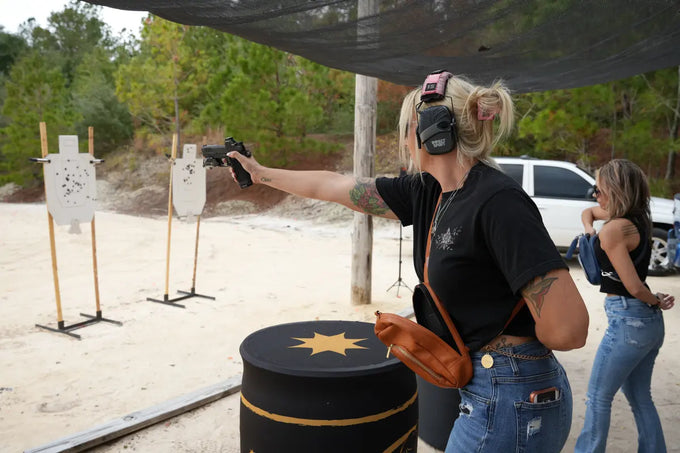
You close that gap with practice. Regular dry-fire work with an unloaded, verified-clear firearm, drawing from your actual bag in your actual carry configuration, is how the benchmark becomes reachable. Practice your unloaded draw until the motion is smooth before you ever ask it to be fast, because smooth is what fast is made of. Track your time from "hand moves" to "sights up" and watch the trend across weeks, not the number on any single day.
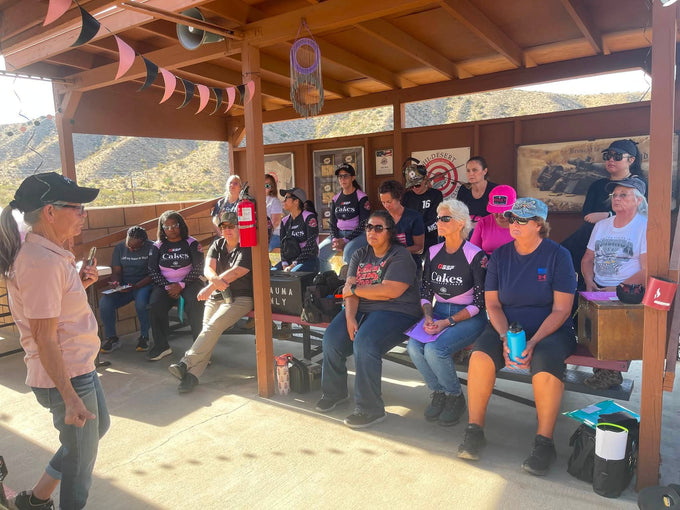
This is also where a brand's priorities show. Cakes Concealed Carry offers its own system training certification, and beyond that, we point customers toward instruction, education, and range time whether or not we gain a thing from it. Arming you with information is part of the product. A bag maker that stops caring the moment the box ships was never selling you a carry system in the first place.
What does the bag itself contribute? A direct path. From carry position, your hand should reach the access point, open the compartment, and land on the grip in one continuous line, with no flaps to peel back, no zipper track to run, and no digging past your daily items. Every intermediate motion the design forces on you is time an attacker keeps.
Test before you buy:
- With an unloaded, verified-clear firearm, time your full sequence from "hand moves" to "sights up"; track the trend, not just the number
- Count the discrete motions the bag forces between reach and grip; fewer is faster, and one is the goal
- Practice with the bag worn the way you actually wear it, crossbody, shoulder, or hand-carried, because access speed changes with position
- Train the draw regularly with dry-fire, because the Tueller benchmark is reached through repetition, not purchased in a box
Feature 5: True One-Handed Operation
Speed and one-handed operation sound like the same feature. They are not. A bag can be fast with 2 free hands and useless with one, and one is what you should plan for.
In a real emergency, assume one of your hands is busy. It might be holding your child's hand, pushing an attacker away, bracing against a wall, dialing 911, or carrying the groceries you had no reason to drop 3 seconds ago. A carry system that requires 2 free hands and your full visual attention is a system designed for a calm day, and calm days are not why you carry.
True one-handed operation looks like this: your non-dominant hand, or the bag's own strap tension against your body, anchors the bag. Your dominant hand executes one continuous motion: locate the access point by feel, open it, acquire a firing grip, and draw. No step in that chain requires your eyes, your other hand, or fine motor precision. Pull-tab systems are the cleanest expression of this, because a single deliberate pull opens the CCW compartment in one movement, with no fine motor gymnastics while your heart rate is spiking.
Feel matters as much as motion. Under stress, in the dark, in winter gloves, your hand has to find the access point without searching. That means a tab or opening you can locate by touch alone, positioned where your hand naturally falls when the bag is worn in your normal carry position. If you have to look down at the bag to open it, the design has already cost you your eyes and your awareness of the threat.
Test before you buy:
- Confirm the CCW compartment opens with one hand, without looking, in a single continuous motion
- Check that the access point is findable by feel alone, with gloves on and eyes closed
- Verify nothing about the opening motion requires your other hand, your teeth, or a flat surface
- Anchor the bag with strap tension only and repeat the test, because your support hand may be occupied
- With an unloaded, verified-clear firearm, run the full one-handed cycle, open, grip, draw, until it works blind every time
Feature 6: A Deployment Mechanism, Not Just a Closure
Stop thinking about the CCW compartment's opening as a closure. A closure is what keeps a makeup bag shut. What a concealed carry handbag needs is a deployment mechanism: an opening engineered to stay sealed against everything the world throws at it, and to deploy instantly on your one deliberate command. Those are opposing requirements, and resolving them is an engineering problem most bags never even attempt.
Cakes Concealed Carry did not arrive at the answer on the first try, and that history is worth sharing because it is the whole argument in miniature. We started with zippers. We tried hook-and-loop. Then we developed and launched our patent-pending magnetic deployment pull-tab system, and for a stretch, all 3 mechanisms were on sale side by side. Customer feedback settled the question decisively: the magnetic system won, and we stuck with it. Zippers demand a 2-point track run and fine motor control that degrades under stress; run it fast and it snags, run it carefully and you have donated seconds you did not have. Hook-and-loop is loud, weakens with every cycle, and announces your draw to the whole room. The magnetic pull tab does neither.
Here is the standard a real deployment mechanism has to meet, and we know because ours has been tested in ways no lab would schedule. One of our customers was in a motorcycle accident and rolled 5 times across the asphalt, and the firearm stayed put inside the bag through all of it. Firearms instructors have thrown a Cakes Concealed Carry bag with an unloaded, verified-clear firearm inside, kicked it across the floor, and tried to jar it open. This matters, because a compartment that can be bumped, dropped, or tumbled open is a hazard riding on your shoulder. The high-strength neodymium magnets hold against every passive force: impact, inversion, a fall, a curious child's casual tug.
But when you pull that tab, it is open for your emergency. One deliberate, directional pull, the specific motion you have trained, and the compartment deploys instantly. The mechanism effectively knows the difference between the world crashing into it and you commanding it, because only your trained pull applies force along the release vector. That is the entire promise in one sentence: sealed against everything except you.
For situations where you want positive lockout, travel, hotel rooms, or any time the bag leaves your direct control, a dedicated locking option adds a security layer you can engage when the tradeoff makes sense and remove when it does not. Lockability should be a mode you choose, not a tax you pay on every draw.
What to evaluate:
- Does the CCW compartment deploy with one deliberate pull, no zipper track to run and no hook-and-loop to rip?
- Does it stay sealed through shaking, tipping, inversion, drops, and impacts, and release only on your trained directional pull?
- Is the mechanism silent to open, so the draw does not announce itself?
- Is there an optional locking mode for travel that you can remove for daily carry?
- After 50 practice deployments with an unloaded, verified-clear firearm, is the mechanism just as positive as it was on day one?
Feature 7: Designed Around the Firearm, Not a Purse With a Pocket
This feature is harder to see on a spec sheet than the others, but it explains all of them: the bag has to be designed around the firearm from the very first sketch. Not a purse that later received a gun pocket. A carry system that later received a beautiful exterior.
The whole concept of Cakes Concealed Carry started with a question about appendix carry. On-body, appendix carry is a proven model: the firearm rides at a consistent position, grip oriented for a natural draw stroke, trigger fully protected, everything indexed to where your hand instinctively goes. So the founding design problem was never "how do we add a gun to a handbag." It was "how do we move appendix carry off-body without losing what makes it work?"
Every downstream decision flows from that framing, and the thought behind everything was the gun. The weight of the firearm, and how that weight is distributed, drives the bag's internal architecture, so the heaviest object you carry sits against structure instead of dragging one corner of the bag into a slump. The location of the frame is chosen so the grip presents at the height and angle your hand already knows, making the draw from the bag a naturally appendix-style draw rather than a new skill you have to build from zero. The compartment geometry, the mounting panel, the deployment tab position, the way the bag hangs on your body: all of it is indexed to the firearm first, and the leather, the hardware, and the silhouette are then made beautiful around that skeleton.
You can feel the difference in 30 seconds of handling. A purse-first bag treats the firearm as cargo, and the gun's weight fights the bag all day: it sags, it swings, it prints, and the draw feels like reaching into someone else's luggage. A firearm-first bag treats the gun as the client, and everything about the carry, the hang, and the draw feels like it was measured to you, because it was measured to the gun your hand is going to.
Verify the Design Against Your Firearm
A bag designed around the firearm still has to be verified against your firearm, and this is the step that turns the design philosophy above into your carry system. "Fits compact pistols" is a marketing phrase, not a measurement. "Compact" and "full-size" are loose categories that vary by manufacturer, and a bag matched to a category instead of a specific gun is guessing on your behalf. Fit is a numbers problem, and you should treat it like one.
Both failure directions are real. A compartment too small for your firearm forces the gun in at an angle, leaves it riding high, or will not let the holster seat fully, and a holster that cannot seat cannot guarantee trigger coverage. A compartment too large lets the holstered gun shift and rotate, which erodes the consistent grip placement you built in Feature 3 and can rotate the grip away from your hand entirely.
The measurements that matter are the compartment's internal width, height, and depth with the holster installed, compared against your firearm's dimensions in that holster. The holster adds real bulk, so bare-gun measurements are not enough. Any serious maker will publish compartment internals; if a brand cannot tell you the numbers, that silence is your answer. Better yet, use a tool built for the question: Cakes Concealed Carry's "Does It Fit?" checker matches your exact make and model against each bag's compartment and holster so you know before you buy, not after.
Then verify in person. When the bag arrives, take an unloaded, verified-clear firearm, seat it in the mounted holster, and run the full sequence: carry position, one-handed deployment, grip, draw, and re-holster. Do it slowly, multiple times. This is the moment the spec sheet becomes your carry system, and it is the only test that counts.
What to look for:
- Evidence the bag was engineered from the firearm outward: published design philosophy, holster-first architecture, a draw stroke that mirrors on-body carry
- Weight distribution that keeps the bag hanging true with a firearm inside, not slumping toward the compartment
- A frame and compartment position that presents the grip at a natural, appendix-style draw angle
- A deployment tab located where your hand already falls in your normal carry position
- Fit confirmed against your firearm's holstered dimensions with a compatibility checker before purchase, and a full unloaded, verified-clear draw cycle on arrival
- If anything about the fit forces a workaround, return the bag; workarounds do not survive stress
- Beauty applied over the carry architecture, never traded against it
What Separates Good From Great
Nothing below will make an unsafe bag safe. But among bags that pass the first 7 features, these 3 are what you will notice every single day, and they are what ultimately decides whether the bag gets carried or gets closeted.
Feature 8: Structure, Materials, and Long-Term Durability
A concealed carry handbag works harder than any other bag you own. It carries the constant weight of a firearm and holster, gets picked up and set down dozens of times a day, and has to do it for years, because a carry system you replace every 9 months is a carry system with scheduled failures.
Structure is not just aesthetics. A bag that sags does 2 bad things at once: it distorts the CCW compartment, warping the draw path you trained on, and it telegraphs its contents, printing the outline of a rigid holster through slouching material. A structured bag holds its architecture under load, and the best ones build that architecture in where you cannot see it, with structural reinforcements layered between the exterior and the interior lining. That hidden skeleton is what keeps the compartment true and the silhouette an ordinary handbag silhouette, year after year, with a firearm's weight inside every day.
Materials are where great bags declare themselves. The leather standard worth insisting on is naturally milled full-grain leather: the hide's strongest layer left intact, tumbled during milling for a supple hand that drapes beautifully and settles firmer into its structure over time instead of collapsing. Do not confuse it with "genuine leather," a label that sounds reassuring and means nothing. "Genuine leather" is a marketing term for low-grade leather, often split or heavily processed leftovers, and it will not carry a firearm's weight gracefully for years. Full-grain is a specification; "genuine" is a shrug.
For gym, range, and outdoor days, the standard shifts to rugged technical nylon built over a reinforced internal frame, so the fabric provides the skin and the frame provides the bones. The construction quality shows in how the bag holds shape under load and how the material shrugs off abrasion, weather, and gear-bag life.
Then read the stitching, because thread is the honest part of any bag. Look for tight, even, dense stitches, reinforcement at stress points, and bar tacks or rivets where straps meet body. Loose threads and wandering seam lines on day one only get worse under a daily 2-pound load.
Structural red flags:
- "Genuine leather" presented as a quality claim; it is a low grade, not a compliment
- "Vegan leather," PU, or any polyurethane-coated fabric posing as leather; it cracks and peels under daily load, often within a year
- Bonded leather, which is leather dust glued to a backing and has none of full-grain's strength
- A bag that slumps or folds when picked up empty
- No internal reinforcement between the exterior and lining; if the walls are just fabric and hope, the compartment will not stay true
- Sparse or uneven stitching, or strap junctions without visible reinforcement
- No published material specs at all; vagueness is a specification
Feature 9: Body-Anchoring Straps, Waist Chains, and Waist Belts
The strap is not an afterthought. It is the interface between your carry system and your body, and it decides both how secure the bag is and whether you can stand carrying it for 12 hours.
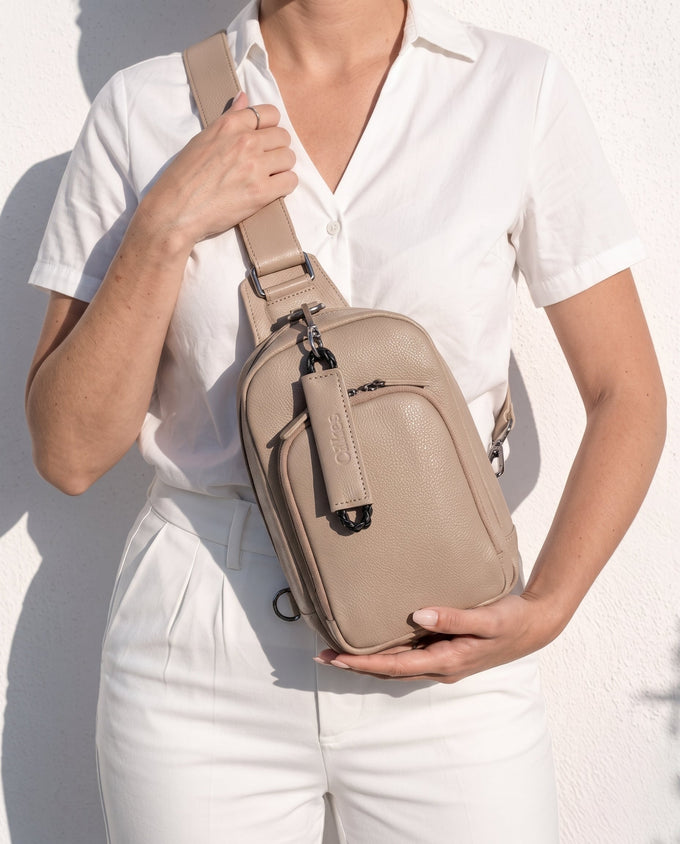
Crossbody carry is the most secure strap configuration for a CCW bag: the strap crosses your torso, the bag anchors against your body, and a snatch attempt has to move you, not just the bag. It also keeps the bag in a consistent position, which keeps your draw consistent. Shoulder carry trades some of that security for convenience and is fine in lower-risk contexts, and sling-style wear splits the difference for athletic days. A great bag lets you choose the configuration; a great strap makes crossbody comfortable enough that you actually choose it.
But a strap alone still leaves one weakness: swing. A firearm is the densest thing in the bag, and when you bend down to grab a toddler, load groceries, or tie a shoe, that weight wants to pitch the bag forward and send it swinging away from your body. This is where Cakes Concealed Carry's waist chains and waist belts change the physics of off-body carry. Worn with the crossbody strap, a waist chain or belt gives you 3 points of stability across your chest and adds an anchor around your waist, pinning the bag to your body instead of letting it hang from a single line. Bend, reach, squat, chase a kid across a parking lot: the bag stays planted against you, the compartment stays where your hand expects it, and the firearm's weight never gets to swing.
Adjustability needs to be precise, not approximate. The goal is the same compartment height against your body whether you are in a summer top or a winter coat, because your draw stroke is trained to a location, and the strap's job is to keep that location fixed across seasons. Smooth slider adjusters beat ladder buckles here: a slider gives you continuous fine adjustment, while ladder buckles jump in coarse steps and force you to accept "close enough." Close enough is not a training standard.
Hardware quality is the difference between a strap that lasts and a strap that fails at the stitch line. Look for durable leather mated to solid metal hardware, not plated plastic. Swivel hardware at the attachment points matters more than most buyers expect: it lets the bag move naturally with your stride without winding the strap into a twist, so the bag hangs flat and the access point stays oriented where your hand expects it.
What to look for:
- Crossbody capability with a strap comfortable enough that you actually wear it that way
- Waist chain or waist belt compatibility that adds chest stability and a waist anchor, so the bag cannot swing when you bend
- Continuous slider adjustment that holds the compartment at the same trained height across seasons and outfits
- Solid metal hardware and durable leather at every junction, with swivels that keep the bag hanging true
Feature 10: Discretion, It Has to Look Like a Regular Handbag (and One You Will Actually Carry)
"Concealed" is doing more work in "concealed carry" than most bags respect. It does not just mean the firearm is hidden. It means the entire carry system is invisible. A bag that announces itself as tactical gear has concealed nothing; it has simply moved the disclosure from the gun to the bag.
That rules out the whole visual language of the tactical aisle: molle webbing, morale patch panels, coyote brown and OD green colorways, aggressive branding. Every one of those signals tells an observant person exactly what the bag is for. Discretion is a tactical advantage, because the entire premise of concealed carry is that no one gets to factor your firearm into their plans. And it is a social advantage, because you should be able to walk into a school pickup line, a client meeting, a restaurant, or a place of worship without your bag making a statement you did not choose to make.
A genuinely discreet bag passes as, and functions as, simply a beautiful handbag. Which brings the list full circle to where it started: the best concealed carry purse for women is the one you will actually carry. Not the one with the most aggressive spec sheet. Not the one that photographs well next to a range bag. The one you reach for every morning without negotiating with yourself, because it goes with your outfit, carries your life comfortably, and happens to be a complete carry system underneath. Safety you'll never carry isn't safety. A concealed carry handbag only protects you on the days it leaves the house, and design is what determines how many days that is.
The Silhouette Test
Hold any candidate bag up against this standard before you buy:
- Would anyone looking at this bag, from any angle, guess what it carries? If yes, it fails
- Does it print, sag, or bulge in a way that outlines the compartment or holster? If yes, it fails
- Does the exterior carry any tactical styling cues, webbing, patches, military colorways, or gun-industry branding? If yes, it fails
- Would you carry this bag even if it held nothing but your wallet and phone? If no, it fails, because it will end up in the closet
- Does it fit your actual life, work, errands, dinners, travel, without a costume change? If no, it will not be there on the day it matters
Putting It All Together: How to Evaluate Any CCW Bag
Remember how this list works: it is ranked in order of priority, and the ranking is a diagnostic tool. The first 7 features are pass/fail. The last 3 decide what you will love. And a carry system is only as strong as its weakest fundamental, so a bag with a flawless strap and a failing holster is a failing bag. Score the fundamentals first, in order, and let a hard failure end the evaluation early no matter how much you like the leather.
Here is the full checklist in one place:
- Holster: rigid Kydex, molded to your specific make and model, full trigger guard coverage, adjustable retention, holster-agnostic mounting with a hard trigger guard included in the box
- Retention: muzzle naturally down, bag vertical; the holster stays mounted through full-speed draws, tuned at home so the firearm always releases before the mounting gives
- Compartment: fully dedicated, fully separated, structurally independent, one occupant only
- Rapid access: a direct path from reach to grip, trained regularly with an unloaded, verified-clear firearm against the Tueller benchmark
- One-handed operation: open, grip, and draw by feel alone, with one hand, without looking
- Deployment mechanism: sealed against impacts, drops, and tumbles, open on one deliberate pull, with an optional lock for travel
- Firearm-first design & fit: appendix-carry geometry moved off-body, weight and frame position indexed to the gun, verified against your exact firearm's holstered dimensions before purchase and confirmed with an unloaded, verified-clear draw on arrival
- Structure & material: naturally milled full-grain leather or rugged technical nylon, reinforced between exterior and interior, with stitching that will outlast the trend cycle
- Strap & waist anchoring: crossbody security, precise slider adjustability, and a waist chain or belt that keeps the bag planted when you bend
- Discretion: passes the Silhouette Test as a beautiful, ordinary handbag you would carry anyway
If you are starting your search, explore the full lineup of concealed carry handbags at cakesconcealed.com, and before you commit to any bag, run your exact firearm through the "Does It Fit?" checker so the first 7 features are settled before the box ever ships.
Because in the end, the 2 theses of this article are really one: a concealed carry handbag has to be engineered enough to protect you and beautiful enough to be with you, and the only bag that ever does the first is the one that manages the second every single day.
And if we can call ourselves successful, it is because our customers walk away with more than a CCW bag. They leave armed with information, connected to training, and confident in a complete carry system they understand top to bottom. That is not a purchase. It is an initiation into a way of life.